
Many businesses assume that when growth slows, the problem is marketing. Sales decline, leads become inconsistent, or engagement drops, and the immediate response is often to launch new campaigns, redesign the website, or increase advertising. While these actions can improve visibility, they do not always address the real issue.
Marketing can amplify a solution, but it cannot create lasting demand for something customers do not truly need. If a product, service, or offer fails to solve a meaningful customer problem, even excellent marketing will struggle to produce sustainable results. Strong campaigns may generate attention, but they cannot compensate for weak product-market fit, poor differentiation, or unmet customer needs.
The danger is that businesses often focus on symptoms instead of root causes. Declining sales may be blamed on marketing when the real issue is customer experience. Low conversions may be attributed to traffic when the actual problem is an unclear value proposition. As a result, companies invest resources into fixes that create activity without creating progress.
Why Businesses Often Solve the Wrong Problem
One of the most common mistakes businesses make is treating symptoms as if they are the problem itself. When sales drop or growth slows, leaders often look for quick explanations and immediate solutions. However, the visible issue is not always the root cause.
For example, declining sales may appear to be a marketing problem when the real issue is poor customer experience, weak differentiation, outdated offerings, or a mismatch between what customers need and what the business provides. More marketing may temporarily increase attention, but lasting growth rarely happens until the underlying issue is addressed.
Confirmation bias can make this worse. Businesses often seek information that supports existing assumptions while overlooking evidence that points elsewhere. Many organizations also become attached to products, features, or ideas before validating whether customers actually need them. Combined with short-term pressure to produce results quickly, this often leads to solving the wrong problem repeatedly.
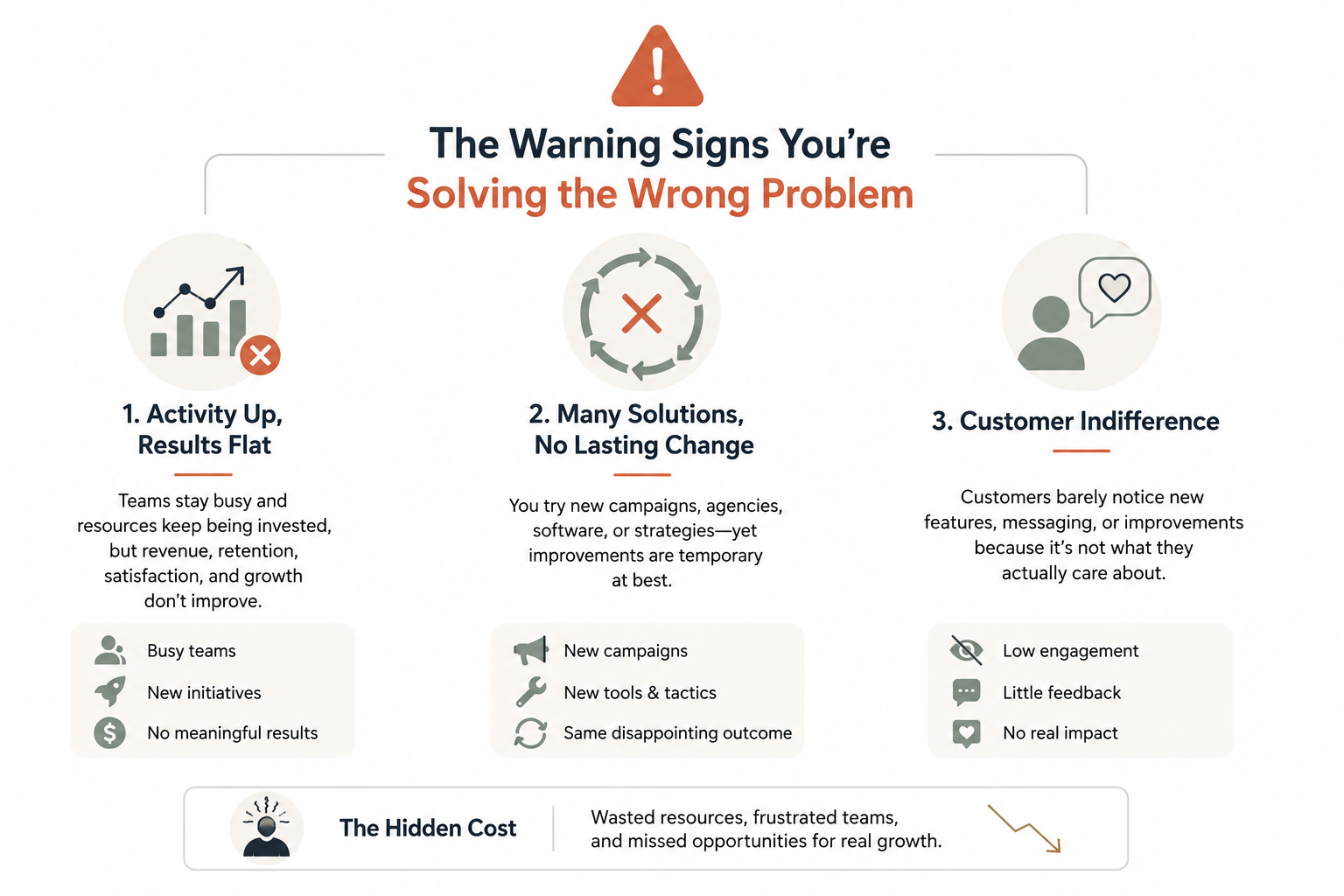
The Warning Signs You're Solving the Wrong Problem
A major warning sign is when activity increases but meaningful results do not. Teams stay busy, new initiatives launch, and resources continue to be invested, yet revenue, retention, customer satisfaction, or growth remain largely unchanged.
Another signal is when multiple solutions fail to create lasting improvement. Businesses cycle through new campaigns, agencies, software, or strategies while expecting each one to finally solve the issue. When improvements remain temporary, it often indicates that the real problem has not been identified.
Customer indifference is another clue. Companies may invest heavily in new features, messaging, or improvements that customers barely notice because they fail to address the issues customers care about most. Over time, this can lead to employee frustration as teams work hard without seeing meaningful progress.
How to Find the Real Problem Beneath the Symptoms
The most effective businesses spend time understanding problems before implementing solutions. Rather than accepting surface-level explanations, they investigate root causes.
One useful approach is the "Five Whys" method, which involves repeatedly asking why a problem exists until the deeper cause becomes clear. What initially appears to be a marketing issue may ultimately stem from customer experience, positioning, operations, or product relevance.
Customer insights are equally valuable. Speaking directly with customers, frontline employees, support teams, and sales staff often reveals frustrations and unmet needs that reports alone cannot explain. Successful organizations also separate assumptions from evidence and define what success looks like before implementing solutions.
Most importantly, they stay focused on customer needs rather than defending existing ideas. Businesses that remain curious and open to feedback are far more likely to uncover the real problem and solve it effectively.
Why the Best Marketing Starts With the Problem
Great marketing begins with understanding the problem customers are trying to solve. People rarely buy products because of features alone. They buy because they want a specific outcome, improvement, or solution to a challenge they already recognize.
When businesses demonstrate a deep understanding of customer struggles, their messaging feels more relevant and trustworthy. Customers are naturally drawn to companies that clearly understand what they are experiencing because it signals expertise and empathy rather than simply promoting a product.
Problem-focused marketing also creates stronger differentiation. Customers tend to remember businesses by the problems they solve, not by technical features or service descriptions. When the problem is clearly defined, messaging becomes more focused, trust grows faster, and marketing efforts become far more effective.

Conclusion
Marketing cannot permanently fix a solution that addresses the wrong problem. While stronger campaigns may generate attention, sustainable growth comes from understanding and solving meaningful customer challenges.
The most successful businesses challenge assumptions, investigate root causes, and continuously validate customer needs. Rather than becoming attached to solutions, they stay focused on the problems customers are trying to solve.
Ultimately, businesses grow faster when they fall in love with the problem instead of the solution. The companies that win long-term are usually the ones that understand customer challenges more deeply than their competitors and build solutions that create genuine value.
FAQs
1. How can I tell if my business is solving the wrong problem?
A common sign is when you continue investing in new campaigns, tools, or initiatives but see little lasting improvement. If activity increases while key results such as sales, retention, or customer satisfaction remain flat, you may be addressing symptoms rather than the underlying issue.
2. Why can’t better marketing fix every business problem?
Marketing can increase visibility and attract attention, but it cannot create sustainable demand for a product or service that does not solve a meaningful customer need. If the underlying offer lacks relevance, stronger marketing often only exposes the problem faster.
3. What is the difference between a symptom and a root cause in business?
A symptom is the visible problem, such as declining sales or low conversions. A root cause is the deeper reason behind it, such as poor customer experience, weak differentiation, unclear positioning, or unmet customer needs. Solving the root cause creates lasting improvement.
4. How can businesses identify the real problem they need to solve?
Businesses can uncover root causes by gathering customer feedback, speaking with frontline employees, analyzing customer behavior, and using techniques such as the Five Whys. The goal is to understand why a problem exists before deciding how to solve it.
5. Why does problem-focused marketing perform better than feature-focused marketing?
Customers are usually more interested in solving a challenge than learning about features. Marketing that demonstrates a clear understanding of customer problems feels more relevant, builds trust faster, and helps prospects see why the solution matters to them.