
Client perception is shaped not only by major campaigns, product launches, or polished branding, but by the everyday moments when clients interact with a business. Response times, website functionality, cleanliness, acknowledgments, and the way mistakes are handled can all influence what clients think about a business. These details may seem insignificant individually, but together they become evidence of reliability, care, professionalism, or inconsistency.
This is why strong branding cannot compensate for a poor everyday experience. What a business promises through its marketing needs to match what clients actually experience. Small interactions can create reassurance and a sense of control when they work well, or frustration and distrust when expectations are not met. These interactions are often described as “moments of truth”—points where customers come into contact with a business and form or change an impression. A strong reputation is ultimately built through a series of small promises that a business consistently keeps.
1. Identify the Everyday Moments That Shape Perception
Clients begin forming opinions before they ever make a purchase. Physical spaces, websites, signage, phone systems, and even the ease of finding information can communicate something about the business. Cleanliness, lighting, maintenance, website speed, working forms, clear information, and accessible contact options may seem like minor details, but they can influence whether a business appears prepared, attentive, and trustworthy.
Responsiveness is another important part of this experience. Clients notice how long it takes to receive a response, especially when they are making a decision or trying to resolve an issue. They may not expect an immediate solution, but they do expect acknowledgment, ownership, and a clear indication of what happens next.
The moments of truth framework helps businesses look at these experiences across the entire customer journey, including discovery, purchase, onboarding, use, support, and renewal. Rather than trying to make every interaction extraordinary, businesses can identify the ordinary moments that have the greatest influence on expectations and make sure those moments consistently reinforce the experience they want to provide.
2. Improve Micro-Interactions and Turn Problems Into Trust-Building Moments
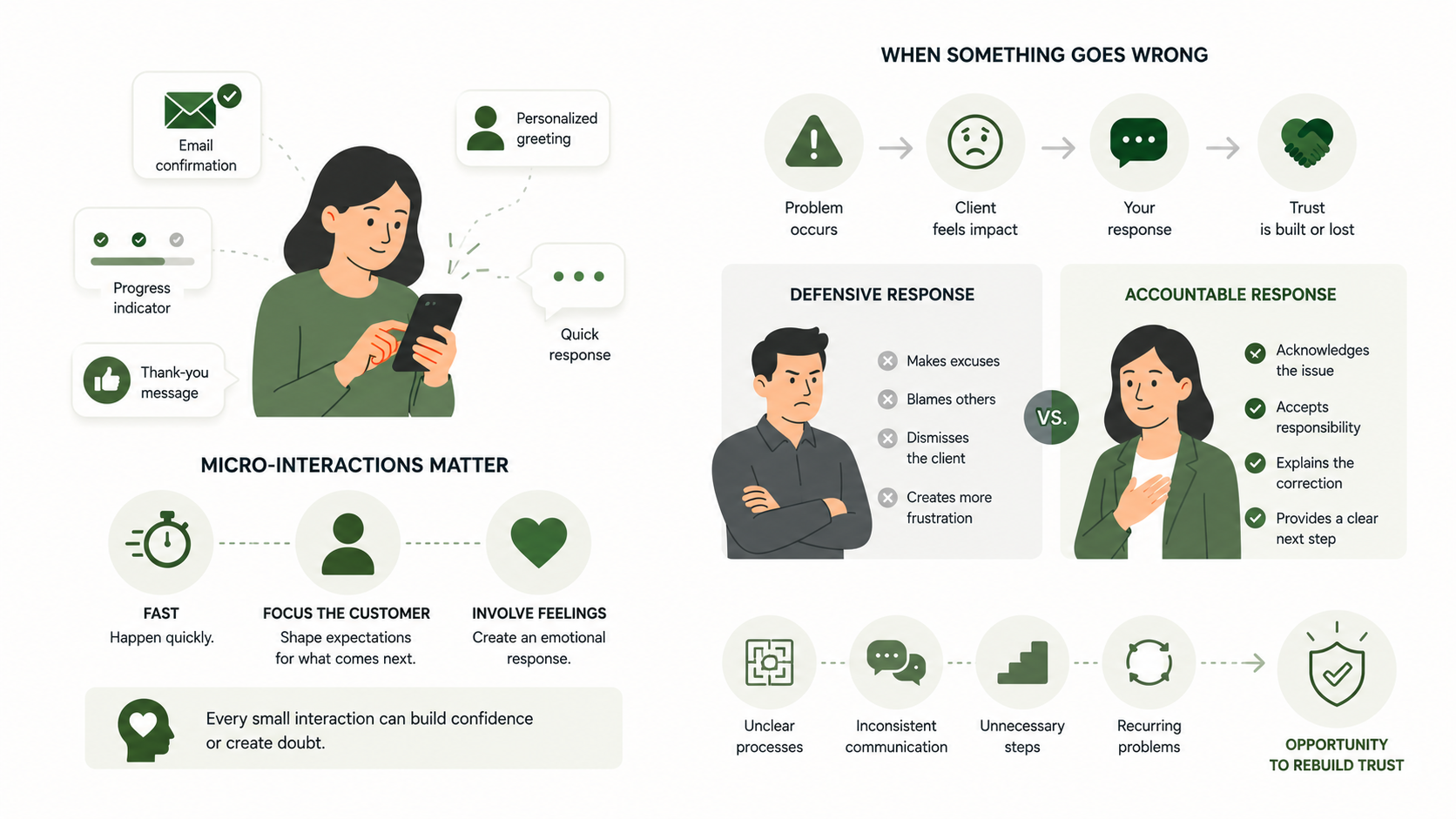
Many customer interactions happen in only a few seconds. An email confirmation, personalized greeting, social media response, progress indicator, thank-you message, or simple acknowledgment can make an experience feel clearer and more human. Immediate feedback can reassure clients that an action worked and give them a sense of control, while silence or unclear feedback can create uncertainty.
These micro-interactions can be understood through the 3 F's: Fast, Focus the Customer, and Involve Feelings. They happen quickly, influence expectations about what comes next, and create an emotional response. Businesses can improve perception by examining the small interactions clients encounter repeatedly and asking whether each one is clear, useful, and human rather than simply whether it technically functions.
The same principle applies when something goes wrong. Clients often learn more about a business from a complaint, delay, failed process, or service mistake than from a normal transaction. A mistake does not automatically damage a relationship; the response can determine what happens next. A defensive response can make the client feel dismissed, while an accountable response acknowledges the problem, accepts responsibility, explains the correction, and provides a clear next step.
Repeated friction can have the same effect. Unclear processes, inconsistent communication, unnecessary steps, and recurring problems can gradually weaken confidence. Clients may not remember every detail of a difficult interaction, but they are likely to remember whether they felt heard, respected, dismissed, or blamed. Service recovery therefore becomes an opportunity to demonstrate accountability and reinforce trust.
3. Focus on the Critical Moments and Build Consistency
Not every customer touchpoint has the same influence on perception. Trying to perfect every interaction can spread resources too thin, so businesses should identify the moments with the greatest emotional, financial, or decision-making impact. Mapping the customer journey across discovery, purchase, onboarding, use, support, and renewal can reveal where clients are most likely to decide whether to buy, stay, expand, or recommend the business.
The research suggests focusing on approximately 5–10 critical moments within a journey or customer segment. Once these moments are identified, businesses can define what a strong experience should look like from the client's perspective. This could mean responding within a specific timeframe, providing a clear next step, resolving an issue without unnecessary repetition, or ensuring that customers receive consistent information regardless of who they speak with.
Clear ownership and measurement also help maintain these standards. Businesses can assign responsibility for important moments and track measures such as conversion, time-to-first-value, first-contact resolution, and customer feedback. This makes customer experience easier to observe and improve rather than treating it as an abstract goal.
Most importantly, consistency turns individual positive experiences into lasting trust. One excellent interaction cannot compensate indefinitely for a pattern of poor ones. When clients repeatedly encounter the same level of care, clarity, and reliability across different channels and employees, those small experiences begin to reinforce one another.

Conclusion
Client perception is rarely determined by one major interaction. It develops through the accumulation of everyday experiences that either confirm or challenge what a business promises. Clients notice how quickly they receive a response, whether an environment feels cared for, whether processes work as expected, and how the business behaves when something goes wrong.
Businesses do not need to create dramatic experiences at every touchpoint. A more sustainable approach is to identify the moments that matter most and make those interactions consistently clear, useful, human, and reliable. Over time, these small experiences shape confidence, trust, satisfaction, and the willingness to continue or recommend the relationship.
Ultimately, a strong reputation is built through small promises kept consistently over time.
FAQs
1. What are the small moments that shape a client's perception of a business?
Small moments include response times, website functionality, cleanliness, clear communication, acknowledgments, and how a business handles mistakes. These everyday interactions can influence whether clients see a business as reliable, attentive, and trustworthy.
2. What are micro-interactions in the client experience?
Micro-interactions are brief moments when clients interact with a business, such as receiving an email confirmation, getting a personalized greeting, seeing a progress indicator, or receiving a quick response on social media. These moments can create reassurance, clarity, or frustration.
3. Why are moments of truth important to customer experience?
Moments of truth are points in the customer journey where clients form or change their impression of a business. Identifying these moments helps businesses focus on the interactions that have the greatest influence on whether customers buy, stay, expand, or recommend.
4. Can a mistake actually strengthen a client relationship?
Yes. A mistake can become an opportunity to build trust when the business acknowledges the problem, accepts responsibility, explains the correction, and provides a clear next step. Clients often learn more about a business from how it responds to problems than from a normal transaction.
5. How can businesses improve the small moments that affect client perception?
Start by mapping the customer journey and identifying the most important touchpoints. Focus on a small number of critical moments, define what a good experience should look like, assign clear ownership, and consistently improve interactions such as responses, confirmations, support, and service recovery.