


Many business owners assume lowering prices is the fastest way to attract more customers and stay ahead of competitors. While discounts can generate short-term sales, they often reduce profit margins, weaken brand positioning, and encourage customers to focus on price rather than value. Businesses that compete primarily on cost frequently find themselves trapped in ongoing price wars where long-term profitability becomes increasingly difficult to maintain.
The reality is that customers evaluate much more than price alone. They also consider quality, expertise, convenience, customer experience, reliability, and the confidence they feel throughout the buying process. Businesses that consistently deliver greater overall value give customers meaningful reasons to choose them without relying on discounts. Instead of competing to be the cheapest, they become easier to trust, easier to remember, and more difficult to replace.
Ultimately, sustainable growth comes from increasing perceived value rather than reducing prices. Strong businesses strengthen their competitive position by improving customer experiences, communicating clear differentiation, and building long-term trust that makes price only one part of the buying decision.
1. Why Value Is More Powerful Than Lower Prices
Customers rarely choose a business based on price alone. They evaluate the complete value they receive, including quality, convenience, expertise, service, reliability, and the outcomes they expect. When businesses clearly communicate these advantages, customers become less focused on finding the cheapest option and more interested in choosing the solution that delivers the greatest overall benefit.
Competing on value also protects long-term profitability. Constant discounts reduce the resources available to improve products, invest in employees, strengthen customer experiences, and continue innovating. Businesses that instead build clear positioning and demonstrate meaningful differentiation create stronger reasons for customers to choose them without relying on lower prices. As perceived value increases, direct price comparisons become less important, allowing businesses to maintain healthier margins while building lasting competitive advantages.

2. Creating Better Experiences That Customers Value
Customer experience often becomes one of the strongest competitive advantages a business can build. Helpful service, smooth purchasing processes, responsive communication, simple onboarding, and reliable support all increase perceived value beyond the product or service itself. When every interaction feels easy and professional, customers become more confident in their decision and less likely to base it solely on price.
Strong branding, positive reviews, customer testimonials, and consistent quality reinforce that confidence even further. Businesses that deliver premium experiences before, during, and after the purchase naturally justify premium pricing because customers believe they receive greater overall value. Rather than competing through discounts, they compete by making every interaction more memorable, trustworthy, and enjoyable.
3. Increasing Value Instead of Reducing Price
Businesses can strengthen their competitive advantage by adding value rather than lowering prices. Flexible service packages, bundled offers, personalized recommendations, educational resources, and expert guidance all improve the customer experience while protecting profitability. These additional benefits help customers feel they receive more without requiring the business to reduce its pricing.
Long-term value also grows through loyalty programs, flexible payment options, exclusive resources, and ongoing customer support. Instead of asking how prices can be lowered, successful businesses continually ask how the customer experience can be improved. Every meaningful improvement strengthens differentiation and makes competitors more difficult to compare on price alone.
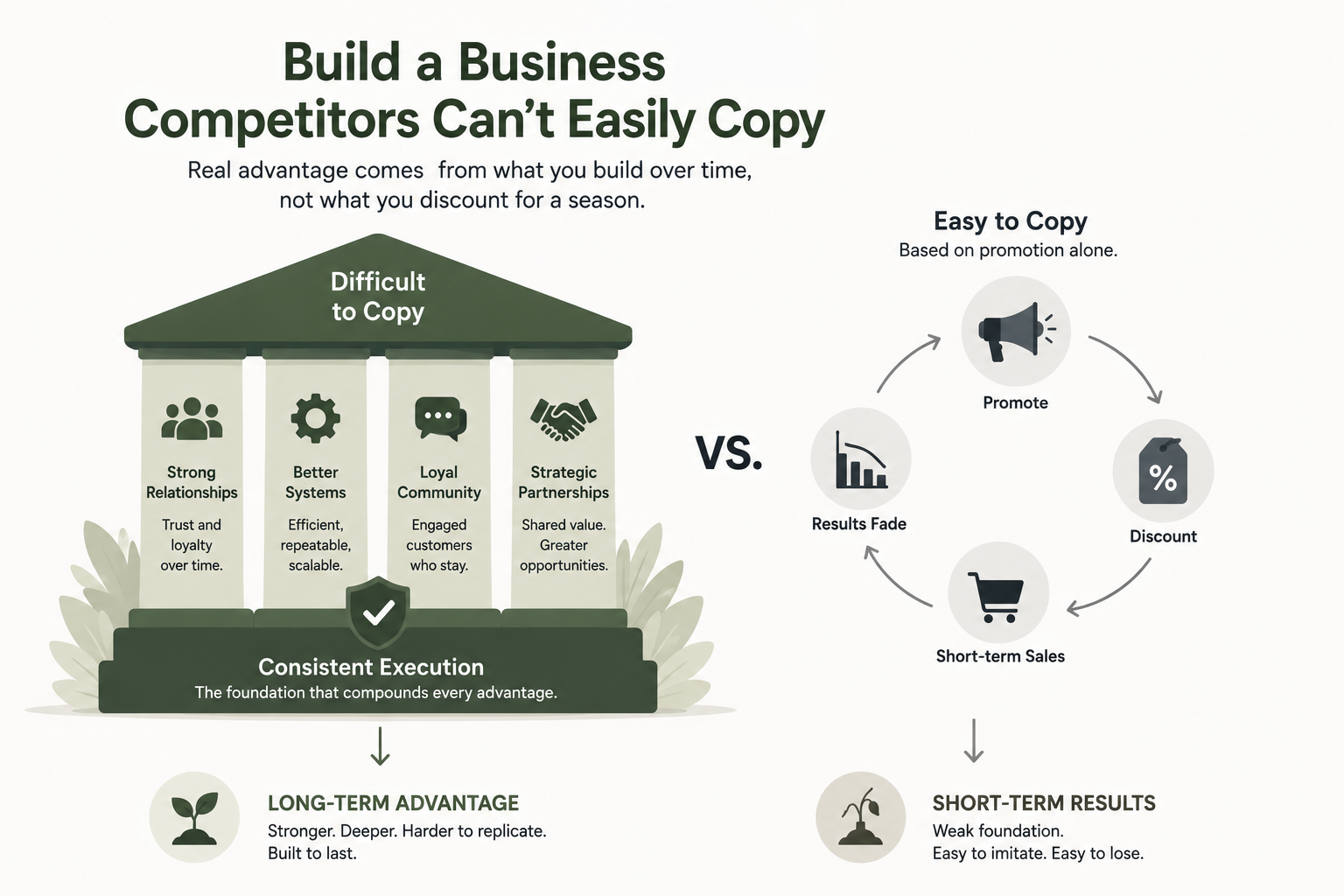
4. Building a Business Competitors Cannot Easily Copy
The strongest competitive advantages come from systems, relationships, and consistent execution rather than temporary discounts. Businesses that focus on a clearly defined audience, build loyal customer communities, develop referral networks, and form strategic partnerships create value that competitors cannot quickly replicate. These long-term assets continue strengthening customer loyalty long after promotional campaigns have ended.
Continuous improvement also keeps businesses competitive as markets evolve. Investing in better products, stronger systems, operational efficiency, employee development, and customer experiences creates organizations that become more valuable over time. Rather than measuring success by offering the lowest prices, successful businesses focus on customer loyalty, profitability, brand strength, and long-term value creation, allowing them to grow without sacrificing sustainable margins.
Conclusion
Competing on price may attract customers temporarily, but it rarely creates lasting competitive advantage. Businesses that consistently increase customer value through better experiences, clear differentiation, trusted relationships, and ongoing improvement become far more difficult to compete against than those relying on discounts alone.
Long-term success comes from making price a smaller part of the buying decision. By strengthening perceived value, investing in customer experience, and building systems that competitors cannot easily copy, businesses create stronger loyalty, healthier profitability, and more sustainable growth without entering a race to the bottom.
FAQs
1. Why is competing on price a risky business strategy?
Competing primarily on price can reduce profit margins, weaken brand perception, and make it difficult to build long-term customer loyalty. Customers attracted only by low prices are also more likely to switch to competitors offering a cheaper alternative.
2. How can a business compete without lowering its prices?
Businesses can compete by increasing the value they provide through better customer experiences, clear positioning, exceptional service, product quality, convenience, and strong brand trust. These factors help customers see greater value beyond price alone.
3. What makes customers willing to pay higher prices?
Customers are often willing to pay more when they believe they are receiving better quality, expertise, reliability, convenience, or service. Strong branding, positive reviews, proven results, and consistent customer experiences also increase perceived value and justify premium pricing.
4. How does customer experience create a competitive advantage?
A positive customer experience builds trust, encourages repeat business, generates referrals, and strengthens customer loyalty. Businesses that consistently make buying easy and deliver reliable service are often chosen over lower-priced competitors because they provide greater overall value.
5. How can businesses build a competitive advantage that competitors cannot easily copy?
Businesses can create lasting competitive advantages by developing strong customer relationships, building repeatable systems, improving operational efficiency, investing in employee development, and consistently delivering exceptional value. These long-term assets are much more difficult for competitors to replicate than temporary price discounts.


