
The Cash Flow Problem Most Freelancers Quietly Accept
Late payment is so common in freelance life that many service providers treat it as a normal cost of doing business. They send an invoice, wait, send a reminder, wait some more, and eventually receive payment — days, weeks, or sometimes months after the work was delivered. Each wait creates cash flow uncertainty, each reminder email carries a low-level awkwardness, and each late payment subtly erodes the professional relationship it affects.
None of this is inevitable. Late payment is largely a systems problem — the result of invoicing at the wrong time, making payment too complicated, failing to set clear expectations upfront, and not using the tools available to collect payment before it becomes a problem.
The freelancers who get paid fastest are almost always those who have built their payment systems around a simple principle: make it as easy as possible for clients to pay, and collect as much as possible before the work is delivered. This article covers the specific tactics, tools, and systems that implement this principle across every stage of the client relationship.
Why Freelancers Get Paid Late: The Root Causes
Understanding why payment delays happen is the starting point for preventing them. Most late payments come from one of five sources:
Invoicing after delivery: When payment is requested after the work is done, the client's motivation to pay quickly is at its lowest — the urgency of getting the work is gone. Post-delivery invoicing is the structural source of most freelance payment delays.
Friction in the payment process: An invoice that requires the client to log into an unfamiliar system, set up a new payment method, or navigate a complex process will be deferred. Every additional step between 'invoice received' and 'payment sent' reduces the chance of immediate payment.
Unclear payment terms: If the invoice does not specify a due date clearly, many clients will treat it as whenever-is-convenient rather than urgent. Vague terms produce vague behavior.
No deposit or upfront payment: Collecting nothing upfront means the client carries no financial stake in the engagement until the final invoice. Deposits shift the payment timeline significantly.
Late invoicing: Sending an invoice days or weeks after the service was delivered introduces delay before the payment cycle even begins. Same-day invoicing is standard for a reason.
The 8 Tactics That Get Freelancers Paid Faster
TACTIC 1
Collect Payment at the Time of Booking
Impact: Very High — eliminates post-service payment entirely for appointment-based work | Effort: One-time setup
For service providers who charge per appointment, this is the single most impactful change available. When payment is collected as part of the booking process — before the appointment takes place — there is no invoice to chase and no post-service payment conversation. The client books, pays, receives a confirmation, and shows up. Book Like A Boss handles this automatically: clients cannot complete a booking without providing payment, and the confirmation is only sent after payment clears.
TACTIC 2
Require a Deposit for All New Engagements
Impact: High — significantly shortens the effective payment timeline | Effort: Low — set once in your booking or invoicing system
For project-based or package engagements where full upfront payment is not standard, a 25 to 50 percent deposit collected at the start of the engagement commits the client financially before work begins. It also reduces the final invoice amount — making it easier to collect — and provides leverage if payment issues emerge.
TACTIC 3
Invoice on the Day the Work Is Delivered
Impact: Medium-High — reduces the built-in delay from late invoicing | Effort: Low — habit change only
Every day between delivering work and sending the invoice is a day added to your payment wait. Invoice on the same day work is delivered or the session occurs. For ongoing clients, invoice on the same day each month. Predictability in your invoicing schedule builds a corresponding predictability in client payment behavior.
TACTIC 4
Make Payment as Easy as Possible
Impact: Medium-High — reduces friction that causes deferral | Effort: Low — choose tools that minimize client-side steps
Your invoice should include a prominent, clickable payment button or link. The client should be able to pay in under 2 minutes without setting up an account or navigating a complex system. Stripe, PayPal, and Square all provide payment links that can be embedded directly in invoices. The fewer steps between 'I received an invoice' and 'I've paid it,' the faster payment arrives.
TACTIC 5
Set Clear Net Terms and State Them Prominently
Impact: Medium — eliminates ambiguity that causes passive deferral | Effort: Low — template change only
Every invoice should state the due date prominently — not 'Net 30' in small print, but 'Payment due by [specific date]' in a visible location. For most service businesses, Net 7 or Net 14 is appropriate for project invoices. Clients who are not given a clear deadline will create their own — which is usually 'when I get around to it.'
TACTIC 6
Set Up Automatic Payment Reminders
Impact: Medium — reduces manual follow-up and catches deferred payments earlier | Effort: Low — one-time setup in invoicing software
Modern invoicing tools like FreshBooks, Wave, and QuickBooks allow you to configure automatic reminder emails that go out when an invoice is approaching its due date and again when it becomes overdue. Set up: a reminder 2 days before the due date ('just a friendly heads-up'), and a follow-up 1 day after the due date if unpaid. This eliminates the manual reminder work and catches most delays before they become significant.
TACTIC 7
Offer Early Payment Incentives
Impact: Low-Medium — motivates faster payment from clients who are responsive to financial incentives | Effort: Low — add to invoice template
A small early payment discount — typically 2 to 3 percent for payment within 3 to 5 days — can meaningfully accelerate cash collection from clients who are organized and financially motivated. State it clearly on the invoice: '2% discount if paid within 5 days.' This tactic is more relevant for larger project invoices than for routine session payments.
TACTIC 8
Move Recurring Clients to Automatic Billing
Impact: High for recurring revenue — eliminates the entire invoicing cycle | Effort: Medium — requires setup conversation with client
For clients on monthly retainers or subscription arrangements, automatic billing via Stripe Billing or a similar tool charges their card on the same day each month without any manual invoicing. No invoice sent. No payment waited for. No reminder needed. The transition conversation with existing clients is simple: 'For the convenience of both of us, I am moving to automatic billing from next month — your card on file will be charged on the 1st each month.'
The Fastest-Pay Invoice: What It Looks Like
A well-designed invoice is not just a record of what is owed — it is a payment facilitation tool. Here is what the fastest-paying invoices consistently include:
- Client name and clear description of what the invoice is for
- Invoice date and a prominent, specific due date ('Due by March 20')
- Itemized services with individual amounts
- Total amount due in large, clear text
- A prominent 'Pay Now' button or clickable payment link directly in the email
- Accepted payment methods listed clearly
- Your contact details for any questions
What the fastest-paying invoices do not include: lengthy payment instructions, multiple steps before reaching the payment page, or small print that buries the due date.
Payment Follow-Up Templates
When automatic reminders are not sufficient and manual follow-up is needed, having pre-written templates avoids the friction of writing from scratch each time and keeps your tone professional even when payment is genuinely overdue.
TEMPLATE 1: Friendly Pre-Due Reminder
Subject: Upcoming payment — Invoice #[XXX]
Hi [Name],Just a quick note to let you know that Invoice #[XXX] for [service/date] — $[amount] — is due on [date].You can pay here: [payment link]Let me know if you have any questions![Your name]
TEMPLATE 2: Day-After Overdue
Subject: Invoice #[XXX] — payment due yesterday
Hi [Name],I wanted to follow up on Invoice #[XXX] for $[amount], which was due on [date]. I have not seen it come through yet — please let me know if there is anything on your end I can help with.Payment link: [link][Your name]
TEMPLATE 3: One Week Overdue
Subject: Invoice #[XXX] — 7 days overdue
Hi [Name],I am following up again on Invoice #[XXX] for $[amount], which is now 7 days past due. I would appreciate payment at your earliest convenience — please use the link below.Payment link: [link]If you are experiencing any difficulty with payment, please reach out and we can discuss options.[Your name]
Invoicing and Payment Tools Compared
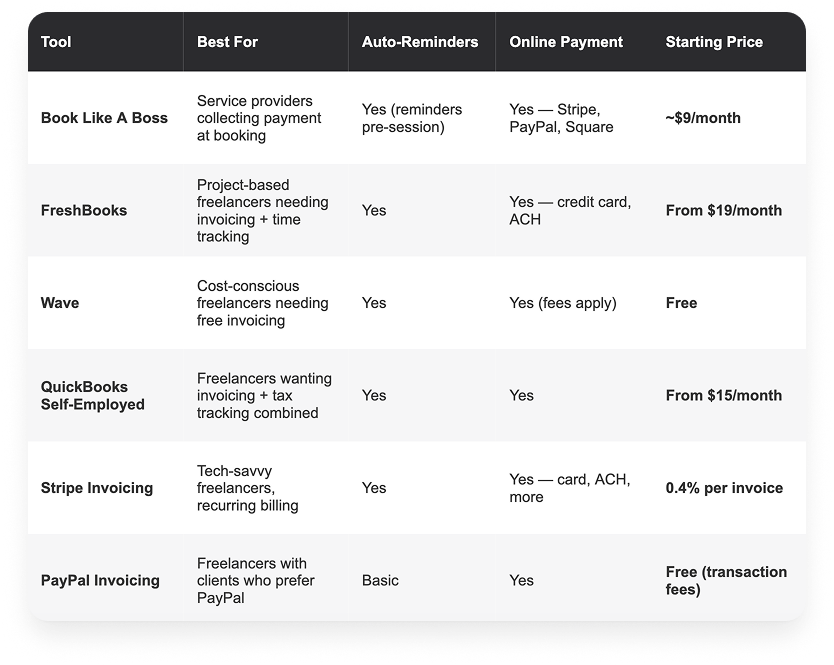
For appointment-based service providers, Book Like A Boss removes invoicing from the equation entirely for session work — payment happens at booking, before any work is delivered. This single change eliminates the majority of payment delays for most freelancers in this category.
Frequently Asked Questions
What is the fastest way for a freelancer to get paid?
The fastest method is collecting payment at the time of booking or project commencement — before any work is delivered. For appointment-based service providers, a booking platform like Book Like A Boss that requires payment to confirm the booking eliminates post-service invoicing entirely. For project-based freelancers, a 50 percent upfront deposit reduces the final invoice amount and establishes a payment pattern from the start of the engagement.
How do I get clients to pay invoices faster?
The most effective changes: use a specific due date (not 'Net 30'), include a prominent clickable payment link in the invoice itself, make the total amount due visually prominent, send the invoice on the same day the work is delivered, and set up automatic reminder emails for approaching and overdue invoices. Each of these reduces friction or ambiguity that causes payment deferral.
What payment terms should freelancers use?
For project invoices, Net 7 or Net 14 (payment due within 7 or 14 days) is standard for most service businesses and sets a clearer expectation than the more corporate Net 30. For larger project invoices, a split payment structure — 50 percent upfront and 50 percent on delivery — is increasingly common and significantly improves cash flow. For recurring services, same-day or 3-day payment terms are appropriate.
Is it professional to ask for payment upfront?
Yes — and increasingly expected. Collecting a deposit or full prepayment at booking is standard practice across coaching, consulting, photography, personal training, and most appointment-based services. Clients who work with professional, established service providers expect to pay something upfront. Requesting upfront payment signals that you value your time and run your business with appropriate standards. Most professional clients find it reassuring rather than off-putting.
What should I do if a client refuses to pay?
Start with direct, professional communication: send a formal final notice with a specific deadline and clear statement of next steps if unpaid. If payment is not received, options include: engaging a collections service (which typically takes a percentage of recovered funds), pursuing the matter in small claims court for amounts within jurisdictional limits, or — as a last resort — writing off the amount and ending the professional relationship. The most effective prevention is strong upfront payment systems that collect as much as possible before work begins.