
Many business owners naturally view increasing revenue as the clearest sign of success. Higher sales often suggest that more customers are buying, demand is growing, and the business is moving in the right direction. While revenue growth is an important indicator of market demand, it is often mistaken for overall business health. In reality, a business can generate impressive sales while quietly struggling with shrinking margins, operational inefficiencies, founder dependency, or cash flow challenges that threaten its long-term stability.
The reason is simple: growth and business strength are not the same thing. Revenue measures how much money enters the business, but it says very little about how efficiently that business operates or whether it can continue performing well as it becomes larger. As companies expand, they add more employees, customers, products, systems, and decisions. Without stronger foundations to support that growth, a business can become larger without becoming more resilient.
Strong businesses understand that sustainable growth requires more than generating sales. They strengthen profitability, improve operational efficiency, invest in scalable systems, and build financial resilience alongside expansion. Rather than measuring success solely by revenue, they focus on creating an organization that continues performing well regardless of changing market conditions.
Ultimately, long-term success comes from building a business that grows stronger as it grows larger. Revenue creates opportunity, but the systems, people, and financial discipline behind that revenue determine whether the business can continue succeeding over time.

1. Revenue Growth Alone Does Not Build a Stronger Business
Revenue growth demonstrates that customers are buying, but it does not automatically indicate that a business is becoming healthier. Sales reflect market demand, while business strength reflects the organization's ability to operate efficiently, remain profitable, and continue growing sustainably. A company can experience rapid revenue growth while becoming less profitable, more operationally complex, and increasingly dependent on constant effort simply to maintain its momentum.
Growth naturally introduces additional complexity. More customers often require more employees, technology, inventory, suppliers, and operational processes. If costs rise just as quickly as revenue, the business becomes larger without becoming significantly stronger. Healthy businesses therefore look beyond sales figures and pay close attention to profitability, margins, cash flow, and operational performance. These indicators provide a clearer picture of whether growth is creating long-term value or simply increasing workload.
Without financial discipline and strong systems, expansion can quietly create fragility. Leaders may overlook inefficient processes, inconsistent execution, or founder dependency because strong sales temporarily hide those issues. As the business grows, however, these weaknesses become increasingly expensive and more difficult to correct. Sustainable growth comes from balancing expansion with operational excellence, ensuring that every stage of growth strengthens the business rather than simply making it bigger.
2. Building Strength Through Systems, Efficiency, and Financial Discipline
Businesses become stronger when growth improves the quality of the organization instead of simply increasing its size. As demand increases, successful companies continually improve efficiency by streamlining workflows, reducing unnecessary complexity, automating repetitive work, and making better use of their resources. Rather than becoming busier simply because they have more customers, they become better at delivering consistent results through smarter operations.
Strong businesses also reduce dependence on individual effort by building repeatable systems. Documented processes, standardized workflows, and clearly defined responsibilities allow teams to perform consistently regardless of who completes the work. Decision-making becomes faster because employees understand their responsibilities and have clear guidelines for solving problems without waiting for constant leadership approval.
Financial discipline strengthens these operational improvements. Healthy organizations focus on increasing profitability alongside revenue, ensuring that additional sales generate meaningful long-term value rather than simply covering rising expenses. They also measure success using a broader set of indicators, including profitability, customer quality, operational efficiency, cash flow, and retention. These metrics help leaders identify opportunities for improvement while ensuring that growth strengthens the business rather than placing additional strain on it.
3. Why Growing Revenue Can Hide Bigger Problems
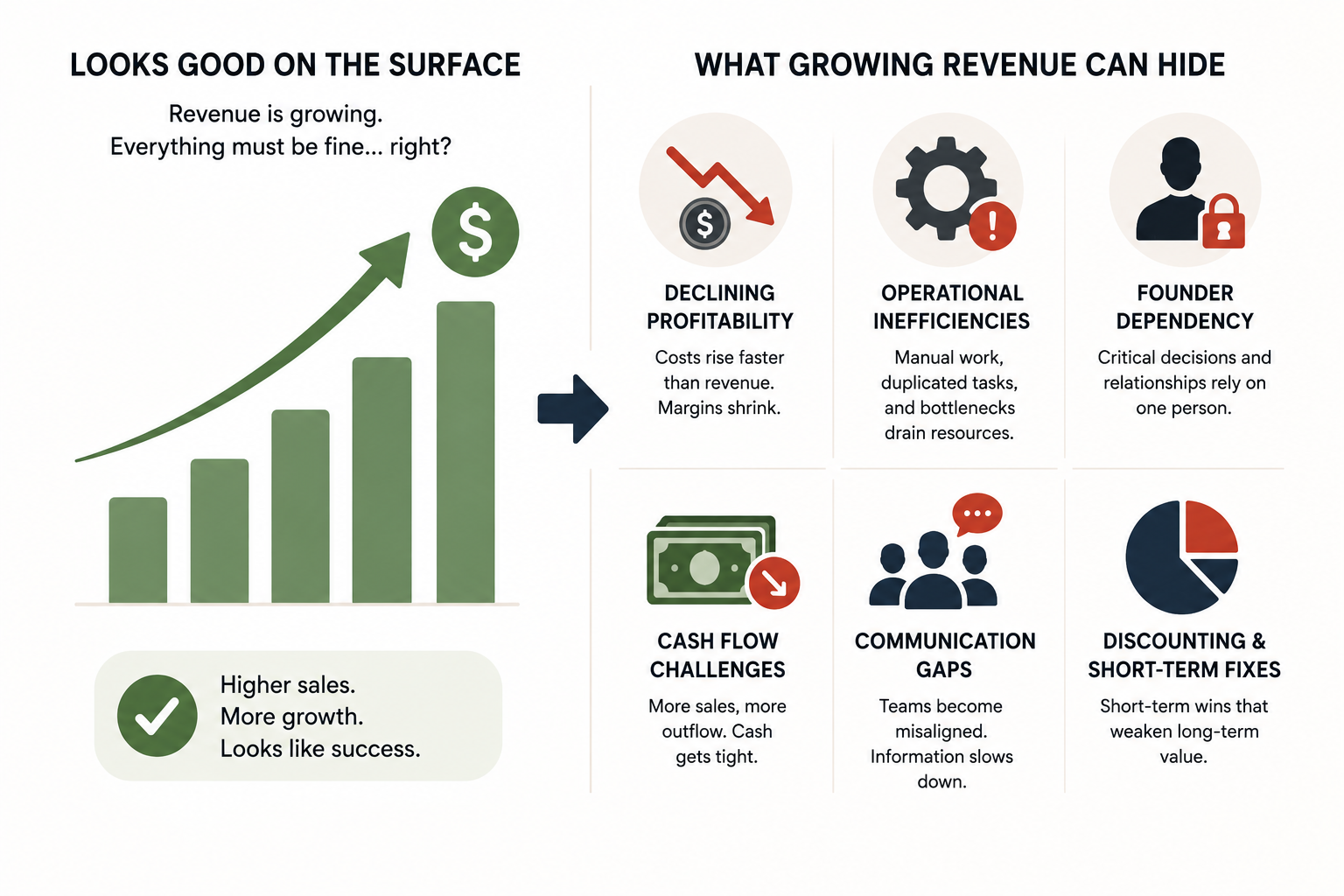
Higher revenue often creates the impression that everything is improving, but growing sales can sometimes conceal problems rather than solve them. As long as revenue continues increasing, leaders may overlook shrinking margins, inefficient processes, operational bottlenecks, or founder dependency because the business appears successful from the outside. Growth creates momentum, but systems determine whether that momentum can be sustained.
One of the most common hidden issues is declining profitability. Sales may continue rising while labor costs, customer acquisition expenses, technology investments, or discounting reduce the value of every additional sale. Operational inefficiencies also become more expensive over time as manual processes, duplicated work, and inconsistent communication consume increasing amounts of time and resources.
Founder dependency presents another significant challenge. Many businesses continue expanding while critical decisions, customer relationships, and operational oversight remain concentrated in one individual. Strong revenue may temporarily hide this weakness, but eventually growth reaches a point where one person's capacity limits the entire organization. Cash flow challenges can emerge for similar reasons, as larger businesses often require greater investment before revenue is fully collected.
For this reason, measuring business health requires looking beyond top-line revenue. Strong businesses identify weaknesses early and strengthen their systems before continued growth magnifies existing problems. Instead of assuming revenue will solve operational challenges, they use growth as an opportunity to build a more resilient organization.
4. Growing Bigger While Becoming Stronger
The strongest businesses treat growth as an opportunity to improve the organization itself. They continuously invest in systems, employee development, financial discipline, and operational improvements that allow the business to perform better as it expands. Every stage of growth strengthens the company's ability to adapt, deliver consistent customer experiences, and operate efficiently without becoming increasingly dependent on individual effort.
Successful leaders also focus on creating long-term enterprise value instead of simply maximizing short-term revenue. They reinvest growth into improving technology, refining processes, strengthening leadership, and building teams that can operate independently. As a result, the business becomes more scalable, more profitable, and more resilient with each stage of expansion.
Rather than measuring success by sales alone, these organizations evaluate whether the business is becoming healthier overall. Strong systems, efficient operations, capable people, and disciplined financial management create businesses that continue performing well even during periods of uncertainty. Growth becomes sustainable because it strengthens the foundation instead of simply increasing its size.
Conclusion
Growing revenue is an important achievement, but it is only one measure of business success. While sales demonstrate market demand, they do not guarantee profitability, operational excellence, or long-term resilience. The businesses that endure understand that sustainable growth requires strengthening the organization alongside expanding its customer base.
Profitability, efficient systems, disciplined leadership, and financial stability allow businesses to continue performing well as complexity increases. Rather than allowing growth to expose weaknesses, successful organizations use each stage of expansion to improve how they operate, empower their teams, and strengthen their foundations.
Ultimately, long-term value comes from building a business that becomes more efficient, more resilient, and more adaptable as it grows. The strongest businesses are not simply those that generate the most revenue. They are the ones that consistently perform well regardless of market conditions because they have invested in the systems, people, and discipline needed to sustain success for years to come.
FAQs
1. Why isn't increasing revenue enough to build a successful business?
Revenue shows that customers are buying, but it does not reveal whether a business is profitable, efficient, or financially stable. Long-term success depends on strong systems, healthy cash flow, operational discipline, and the ability to continue performing well as the business grows.
2. What metrics should businesses track besides revenue?
In addition to revenue, businesses should monitor profitability, gross and net margins, cash flow, customer retention, customer lifetime value, operational efficiency, and employee productivity. These metrics provide a more complete picture of overall business health and sustainability.
3. How can rapid business growth create operational problems?
Rapid growth can increase complexity by adding more customers, employees, and processes before the business has the systems to support them. This can lead to communication issues, operational bottlenecks, declining margins, founder dependency, and cash flow challenges if not managed carefully.
4. What makes a business more resilient as it grows?
Resilient businesses invest in repeatable systems, clear processes, financial discipline, capable teams, and strong leadership. They improve efficiency alongside revenue so they can adapt to changing market conditions without sacrificing performance or profitability.
5. How can business owners strengthen their company while increasing revenue?
Business owners can strengthen their company by reinvesting growth into better systems, employee development, technology, and operational improvements. Focusing on profitability, delegation, process optimization, and long-term planning helps ensure that every stage of growth makes the business stronger rather than simply larger.