
Most businesses think their offer is clear.
Until they watch a potential client try to explain it back.
Suddenly, the confusion becomes obvious. Too many features. Too much information. Too many explanations layered on top of each other. What feels logical internally often feels dense and difficult externally.
And that disconnect quietly hurts conversions.
Because clients are not seeing your offer the way you see it. They are seeing fragments — scattered benefits, technical language, long descriptions, and feature-heavy messaging that requires too much mental effort to decode.
That creates a dangerous problem:
If people cannot quickly understand what your offer actually changes for them, they are far less likely to buy it.
The issue is rarely a lack of value. More often, it is a lack of clarity.
The Confusing Offer Problem
Inside a business, everything makes sense.
The systems connect. The features feel important. The process feels logical. But customers do not experience your offer from the inside. They experience it for the first time, with limited context and limited attention.
That means they are not trying to understand every detail. They are trying to answer one simple question:
“What does this actually do for me?”
When that answer gets buried beneath jargon, technical explanations, or endless feature lists, confusion takes over. And confused people rarely convert.
One of the biggest mistakes businesses make is assuming that more explanation automatically creates more trust. In reality, over-explaining often creates cognitive friction. Customers stop feeling informed and start feeling overwhelmed.
Instead of understanding the value clearly, they begin mentally translating what everything means.
And the more mental effort required, the faster attention disappears.
Why Most Offers Fail to Land
There are three common reasons offers become harder to understand than they need to be.
1. The Feature Trap
Businesses often explain what their offer includes instead of what those inclusions actually achieve.
But customers do not buy features.
They buy outcomes.
A client usually cares less about the process itself and more about what the process improves: more time, less stress, better results, increased revenue, smoother operations, or clearer organization.
Without that translation, even strong offers can feel abstract.
2. Insider Bias
The closer you are to your business, the harder it becomes to recognize what outsiders do not understand.
Internal terminology feels obvious because you work with it every day. But customers are encountering it for the first time. What feels “clear” internally often sounds vague or overly technical externally.
That gap creates misalignment between how businesses explain their offers and how customers actually interpret them.
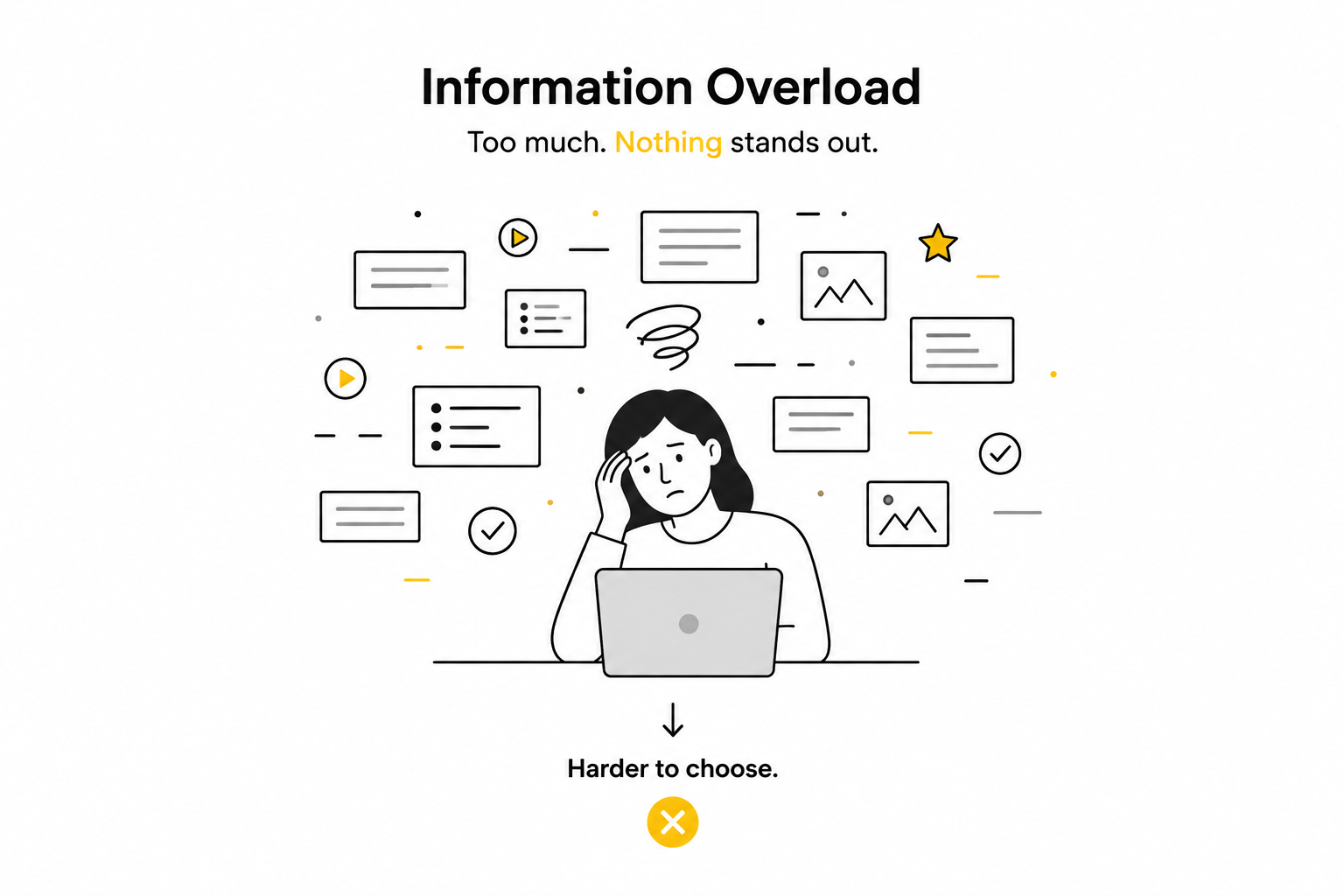
3. Information Overload
More detail does not always create more clarity.
In many cases, it creates the opposite.
When every feature, benefit, and detail receives equal attention, nothing stands out anymore. Customers struggle to identify the main value because too many ideas compete for attention at once.
And when everything feels important, decision-making becomes harder.
The Shift From Features to Outcomes
The businesses with the clearest messaging usually make one important shift:
They stop focusing on what the offer is and start focusing on what the offer changes.
Instead of leading with technical breakdowns, they lead with results. Instead of listing every included feature, they emphasize the real-world outcome customers care about most.
That shift simplifies decision-making immediately.
Because customers do not want to work hard to understand value. They want clarity fast.
This is where simplification becomes strategic.
Not “dumbing things down.” Not removing value. But removing unnecessary complexity that blocks understanding. Strong messaging highlights the core problem being solved and removes distractions that do not directly support that message.
The result is an offer that feels easier to understand, easier to trust, and easier to buy.
Conclusion
The strongest offers are rarely the most detailed.
They are the most focused.
Clear messaging does not happen by accident. It happens when businesses stop trying to explain everything and start communicating the one thing customers actually need to understand.
What problem do you solve?
What changes after someone works with you?
Why should they care immediately?
The easier those answers are to grasp, the easier decisions become.
Because clarity reduces friction. Clarity builds confidence. And clarity converts faster than complexity ever will.
At the end of the day, there is one question every business should ask:
If a stranger heard your offer once, would they instantly understand it — or would they need a second explanation?
FAQs
Why do clients struggle to understand what a business is selling?
Usually because the message is too complex. Businesses often rely on jargon, feature lists, or internal language that does not clearly explain the real-world value to the customer.
Is it bad to include features when describing an offer?
No — but features should support the message, not lead it. Customers care more about outcomes than technical details alone.
What’s the difference between features and outcomes?
Features explain what something includes. Outcomes explain what improves for the customer. Most buying decisions are driven by outcomes.
How can I tell if my messaging is too complicated?
If someone outside your industry cannot understand your offer quickly in one sentence, your messaging likely contains too much complexity.
What’s the fastest way to make an offer clearer?
Start by identifying the core problem you solve. Then simplify your messaging around the outcome customers care about most and remove anything that creates unnecessary confusion.