Many businesses believe consistent growth requires constant advertising, promotions, and marketing campaigns. Whenever sales slow, the instinct is often to spend more on advertising, publish more content, or launch another promotion. While these efforts can generate short-term attention, they often create a business that depends on continuous marketing simply to maintain momentum. As soon as promotional activity slows, inquiries and revenue frequently begin slowing as well.
The challenge is that promotion creates awareness, but it does not create sustainability by itself. A business may become highly effective at attracting attention while still relying on inefficient processes, inconsistent customer experiences, or constant founder involvement to convert and retain customers. In these situations, marketing is forced to compensate for weaknesses elsewhere in the business instead of amplifying a strong foundation.
Businesses become far more resilient when growth depends on repeatable systems rather than constant effort. Strong customer relationships, efficient processes, referral networks, educational content, and reliable operations continue generating value long after individual campaigns have ended. Marketing remains important, but its role shifts from creating every opportunity to accelerating systems that already produce consistent results. Long-term success comes from building assets that continue working even when promotion slows.
1. Why Systems Create More Sustainable Growth Than Promotion
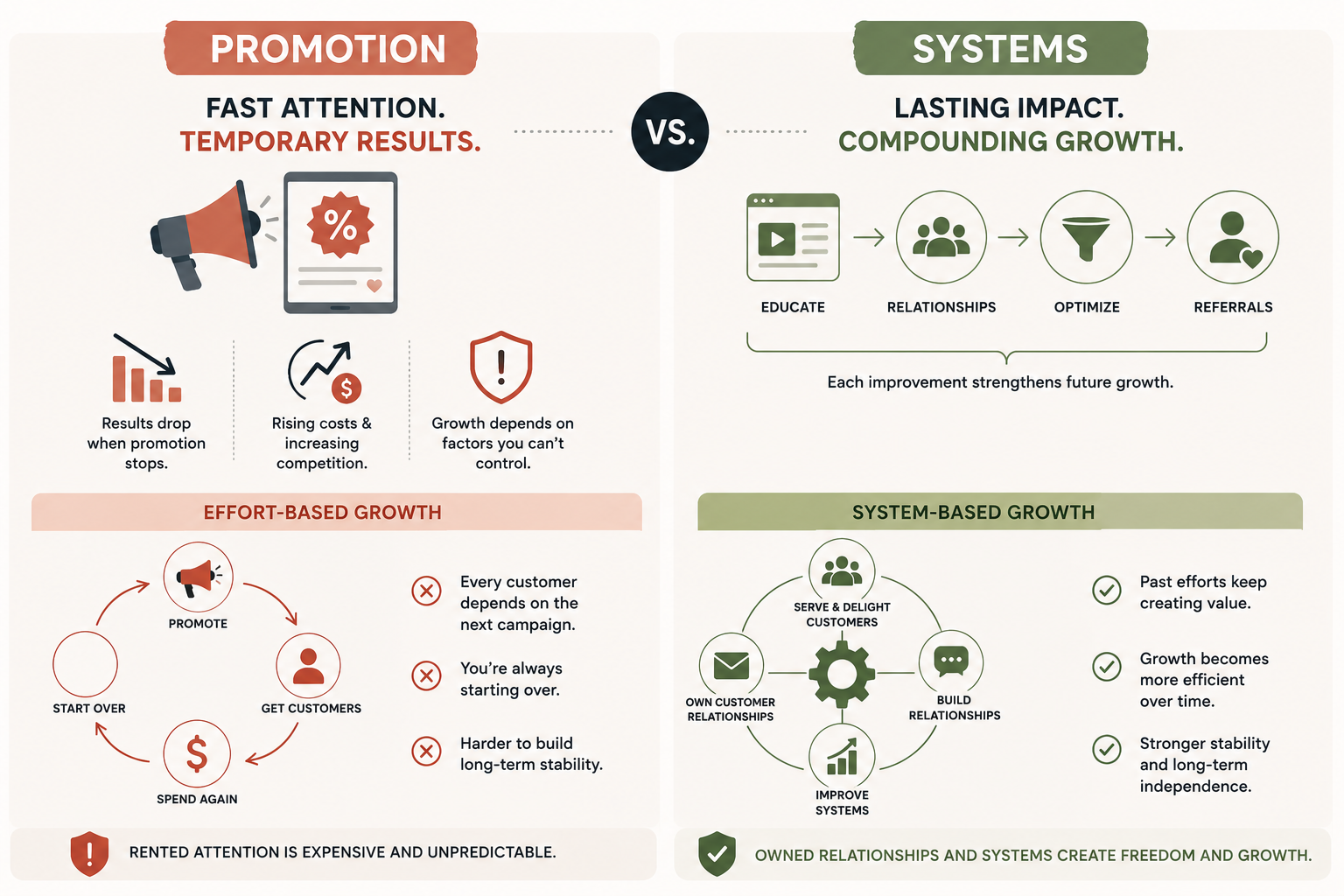
Promotion is one of the fastest ways to attract attention, but its impact is often temporary. Advertising campaigns, discounts, and social media marketing can quickly generate leads, yet those results usually decline once spending or promotional activity stops. Businesses that rely heavily on paid visibility also become vulnerable to rising advertising costs, platform changes, and increasing competition because much of their growth depends on factors they cannot control.
The difference lies in whether a business relies on effort-based growth or system-based growth. Effort-based growth requires continuous marketing because every customer depends on another campaign. System-based growth allows previous efforts to continue creating value through educational content, customer relationships, optimized conversion processes, and referral systems. Rather than constantly starting over, each improvement strengthens the business and contributes to future growth. Businesses that own customer relationships instead of relying solely on rented attention build greater stability while reducing long-term dependence on continuous promotion.
2. Building Systems That Turn Customers Into Repeat Customers
Businesses that grow consistently create systems that guide prospects naturally from interest to purchase while encouraging them to return and recommend the business to others. Clear offers, simple pricing, straightforward booking or checkout processes, and well-designed customer experiences reduce friction and make purchasing easier. Customers spend less time deciding and more time confidently moving forward because the buying journey feels clear and predictable.
Strong operational systems reinforce these experiences. Streamlined communication, scheduling, payments, customer support, and automation improve consistency while reducing manual work. Reliable service encourages repeat business, referrals, and stronger customer loyalty because customers know they can expect the same positive experience every time. Instead of relying on constant promotions to replace lost customers, businesses build customer relationships that continue generating future revenue through trust and satisfaction.
3. Creating Predictable Growth Beyond Marketing Campaigns
Sustainable businesses create multiple customer acquisition systems that continue producing results long after individual campaigns end. Referral programs, strategic partnerships, educational content, and self-service resources all help attract customers without relying entirely on paid advertising. Articles, videos, webinars, guides, and FAQs continue answering customer questions while demonstrating expertise, allowing businesses to remain visible even when they are not actively promoting themselves.
Customer data, sales conversations, and feedback further strengthen these systems by identifying opportunities to improve content, conversion rates, and customer experiences. When acquisition, conversion, retention, and referrals work together, growth becomes increasingly predictable because each satisfied customer contributes to future opportunities. Rather than depending on isolated campaigns, businesses create a continuous growth system where every improvement supports the next.
4. Building a Business That Grows Beyond the Founder
Sustainable growth also requires reducing dependence on the founder. When every important decision, customer interaction, or operational process depends on one person, the business eventually becomes limited by individual capacity. Documenting processes, standardizing workflows, delegating responsibilities, and automating repetitive tasks allow the organization to operate consistently regardless of who performs the work.
As employees gain ownership and systems become more reliable, leaders can focus on strategy, innovation, customer relationships, and long-term growth instead of daily execution. Success is no longer measured by how much work the founder personally completes but by how effectively the business performs without constant supervision. Businesses become truly scalable when repeatable systems, capable teams, and efficient operations continue creating value independently.

Conclusion
Marketing will always play an important role in business growth, but businesses that rely entirely on constant promotion often struggle to build lasting momentum. Promotion creates opportunities, but systems determine whether those opportunities become sustainable growth. Strong customer experiences, repeatable processes, operational discipline, and long-term customer relationships continue producing results long after individual campaigns have ended.
The businesses that grow most consistently are often not the ones that market the most. They are the ones that build systems that attract customers, convert them efficiently, encourage repeat business, and generate referrals regardless of how frequently they advertise. By investing in scalable processes instead of relying solely on continuous promotion, businesses create growth that becomes stronger, more predictable, and more resilient over time.
FAQs
1. Why is relying on constant promotion risky for a business?
Businesses that depend heavily on ongoing advertising or promotions often experience inconsistent sales when marketing activity slows. Building strong systems, customer relationships, and repeatable processes creates more stable growth that continues beyond individual campaigns.
2. How can a business generate customers without constantly advertising?
A business can reduce its reliance on constant promotion by creating valuable educational content, improving customer experiences, building referral programs, optimizing conversion systems, and maintaining long-term relationships with existing customers. These assets continue attracting and converting customers over time.
3. What systems help create sustainable business growth?
Sustainable growth is supported by systems that improve customer acquisition, conversion, retention, and referrals. Clear sales processes, automated workflows, consistent customer experiences, and documented operating procedures allow businesses to grow more efficiently while reducing dependence on continuous marketing efforts.
4. Why are repeat customers and referrals important for long-term growth?
Repeat customers and referrals lower customer acquisition costs and create a more predictable source of revenue. Businesses that consistently deliver positive customer experiences often generate organic growth because satisfied customers are more likely to return and recommend the business to others.
5. How can business owners reduce dependence on themselves and constant promotion?
Business owners can build greater resilience by documenting processes, delegating operational responsibilities, automating repetitive tasks, and investing in systems that consistently attract and serve customers. This allows the business to continue growing even when promotional activity or founder involvement decreases.
.webp)