
A business can deliver a high-quality product or service and still leave a client disappointed. Another client might receive an ordinary experience and feel pleasantly surprised. The difference is often what each client expected before the experience began.
This is the central idea behind Expectancy-Disconfirmation Theory, which explains satisfaction as a comparison between expectations and actual performance. Clients do not judge an experience entirely on its own; they compare what they received with what they believed would happen.
This means businesses need to consider not only the experience they deliver, but also the expectations they create through their communication, reputation, promises, and previous interactions.
1. Satisfaction Depends on the Gap Between Expectations and Reality
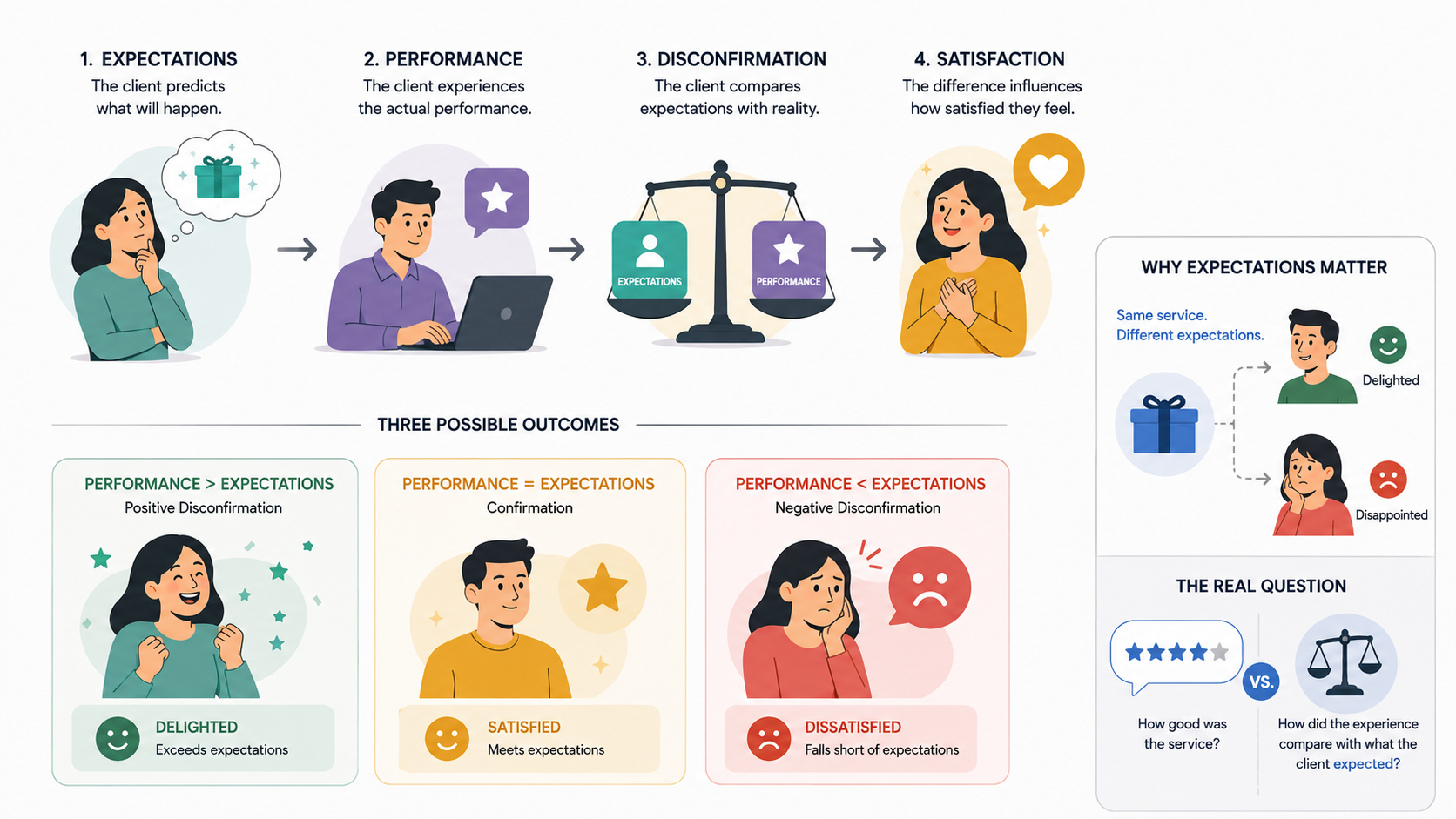
Expectancy-Disconfirmation Theory centers on four elements: expectations, performance, disconfirmation, and satisfaction. Clients begin with a prediction about what will happen, experience the actual performance, and then compare the two. The difference between expectation and performance influences how satisfied they feel.
There are three possible outcomes. When performance exceeds expectations, clients experience positive disconfirmation and may feel delighted. When performance matches expectations, they are likely to feel satisfied. When performance falls below expectations, negative disconfirmation can lead to dissatisfaction.
This explains why quality alone does not determine satisfaction. Two clients can receive exactly the same service but react differently because they entered the experience with different expectations. Excellent service can disappoint when expectations were even higher, while an average experience can feel exceptional when expectations were low.
The important question is therefore not only, “How good was the service?” but also, “How did the experience compare with what the client expected?”
2. What Shapes Client Expectations Before They Buy
Client expectations are formed long before the actual service takes place. Business communications, brand image, word-of-mouth, media coverage, and previous experiences can all establish the standard clients use to evaluate an experience.
A website promising fast delivery, an advertisement emphasizing premium quality, a proposal outlining a specific outcome, or a recommendation from another client can all influence what someone expects. Previous experiences can reinforce those expectations, whether positively or negatively.
Clients can also hold different levels of expectation. A predictive expectation represents what they believe will actually happen. An ideal standard represents the best outcome they could imagine, while a minimum tolerable level represents the lowest outcome they are willing to accept.
This means a client does not necessarily need to receive the best possible experience to be satisfied. They may be satisfied when the experience meets their expected standard and delighted when it goes beyond it.
For businesses, expectation management therefore begins with understanding the standards they are creating. The promises made before a purchase become part of the experience itself.
3. Why High Expectations Can Both Help and Hurt Satisfaction
High expectations can make satisfaction harder to achieve because they give the client a more demanding standard against which to judge performance. However, the research also shows that expectations can influence how clients perceive the performance itself.
This creates a double-edged effect. Clients with high expectations may be more difficult to satisfy if the actual experience falls short. At the same time, high expectations can sometimes lead clients to perceive the experience more positively through a placebo effect.
Confirmation bias can contribute to this. Clients may interpret an experience in ways that reinforce what they already expect. Someone who expects a business to perform well may interpret uncertain details more positively, while someone with low expectations may be more likely to notice shortcomings.
This does not mean businesses should simply lower expectations. The better approach is to understand what clients expect and make sure those expectations are realistic and aligned with what the business can consistently deliver.
The objective is to avoid a disconnect between what clients believe they are going to receive and what the business can actually provide.

4. Manage Expectations to Improve Satisfaction
Businesses can influence satisfaction not only by improving their performance, but also by managing expectations before the experience begins.
This starts with setting accurate timelines, clearly explaining the scope and expected outcomes, avoiding unrealistic promises, communicating consistently, and providing evidence that helps clients understand the quality of the service. Educating clients can also make it easier for them to evaluate the experience fairly.
The familiar “under-promise, over-deliver” approach can be useful, but the research provides an important qualification. When clients are able and motivated to evaluate the service, realistic or slightly understated expectations can create an opportunity to exceed the baseline. When clients have limited ability or motivation to evaluate the experience, increasing expectations can sometimes influence their perception more positively.
Expectation management should therefore not mean deliberately lowering standards or making a service appear better than it is. It means creating a realistic baseline and then consistently meeting or exceeding it.
Businesses should look closely at every point where expectations are created, from marketing and sales conversations to proposals, timelines, onboarding, and previous interactions. When those messages accurately reflect the experience clients will receive, there is less opportunity for negative disconfirmation.
Conclusion
Client satisfaction is shaped by the relationship between expectations and performance, not by service quality in isolation. The same experience can create delight, satisfaction, or disappointment depending on the standard the client brought into it.
Businesses therefore need to pay attention to the expectations they create through their branding, communication, promises, reputation, and previous experiences. Improving the actual experience remains important, but managing the expectation surrounding that experience is equally significant.
The goal is not simply to do more. It is to set realistic expectations, deliver on them, and create opportunities to exceed them.
Ultimately, a better customer experience begins before the client ever experiences it.
FAQs
1. Why do client expectations affect satisfaction?
Client satisfaction depends partly on how the actual experience compares with what they expected beforehand. When performance exceeds expectations, clients may feel delighted; when it falls short, they may feel dissatisfied, even if the service is objectively good.
2. What is Expectancy-Disconfirmation Theory?
Expectancy-Disconfirmation Theory explains satisfaction as the result of comparing expected performance with actual performance. The comparison produces positive, zero, or negative disconfirmation, which can lead to delight, satisfaction, or dissatisfaction.
3. Where do client expectations come from?
Client expectations can come from business communications, brand reputation, advertising, reviews, word-of-mouth, media coverage, and previous experiences. These sources establish the standards clients use to evaluate the experience.
4. Can high expectations actually improve customer satisfaction?
Sometimes. Research suggests that high expectations can make satisfaction harder to achieve, but they can also influence clients to perceive performance more positively through expectation-related effects and confirmation bias. The impact depends on how capable and motivated clients are to evaluate the service.
5. How can businesses manage client expectations effectively?
Businesses can set realistic expectations by communicating accurate timelines, clearly defining scope and outcomes, avoiding unrealistic promises, providing evidence of quality, and educating clients about the service. The goal is to create an accurate baseline that the business can consistently meet or exceed.