


Many businesses believe they compete on value when they are actually spending most of their time defending their prices. The difference is significant. Competing on value means helping customers understand the outcomes, benefits, and transformation they receive. Justifying price focuses on explaining costs, features, or expenses in an attempt to make a purchase seem reasonable.
Customers rarely buy based on price alone. They care about results. Whether they want to save time, increase revenue, reduce risk, improve convenience, or solve a problem, they evaluate purchases based on the value they expect to receive. Businesses that clearly communicate those outcomes attract stronger customer loyalty, healthier margins, and less price-sensitive buyers. Businesses that focus primarily on cost often find themselves trapped in price comparisons and discount conversations.
1. The Signs of Price Competition and Why Customers Pay for Value
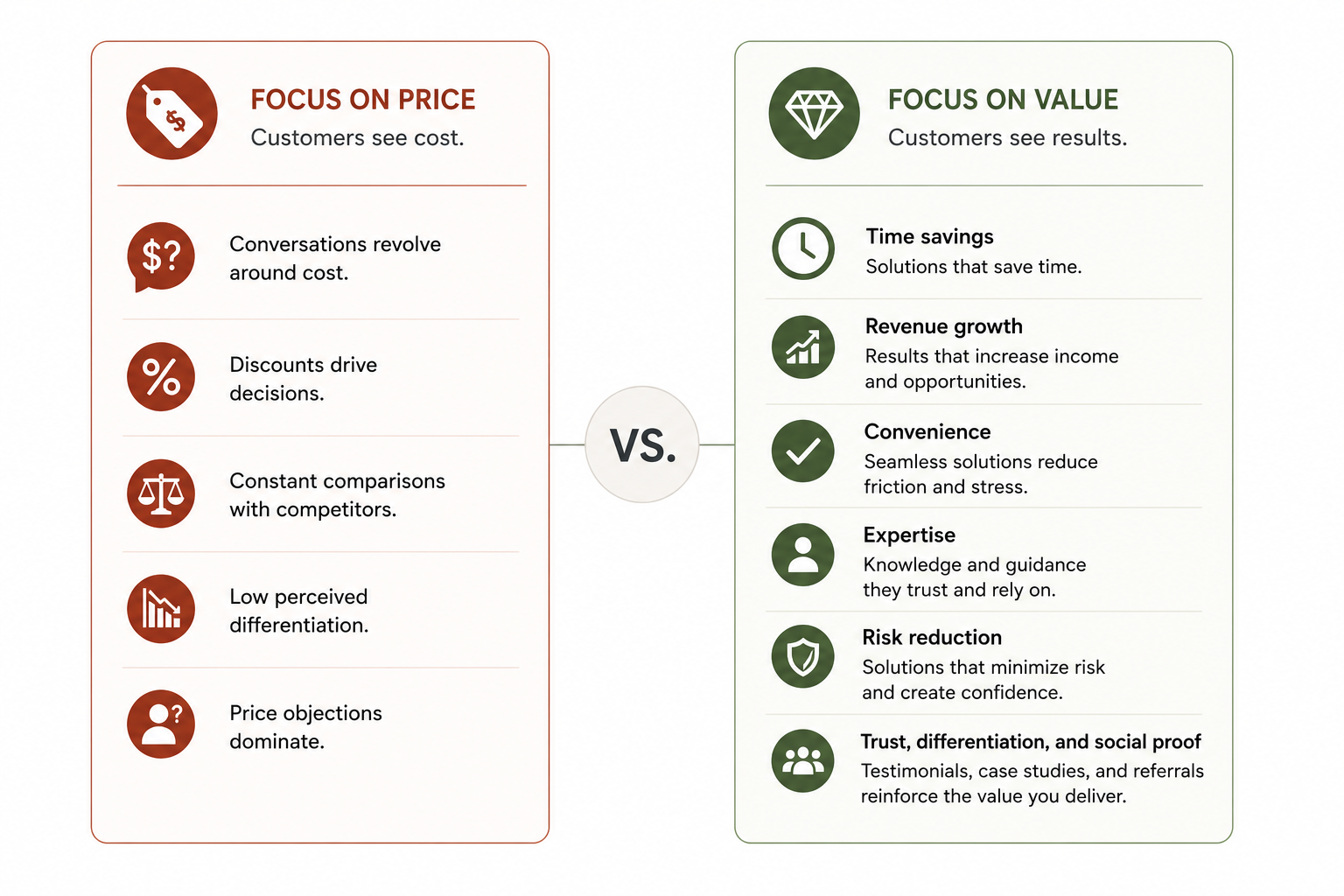
One of the clearest signs that a business is competing on price rather than value is when customer conversations revolve around costs, discounts, and comparisons. When prospects do not clearly understand the value being offered, price naturally becomes the easiest factor to evaluate.
Customers are ultimately buying outcomes, not products or services. They want confidence that an investment will help them achieve a meaningful result. Time savings, revenue growth, convenience, expertise, and risk reduction all contribute to perceived value. Trust, differentiation, and social proof strengthen that perception even further.
Businesses that clearly demonstrate results through testimonials, case studies, referrals, and customer success stories make pricing conversations easier because customers focus on the return they expect to receive rather than the cost itself.
2. Why Businesses Fall Into the Price Trap
Many businesses do not intentionally compete on price. Instead, they drift into it because of short-term sales pressures, weak differentiation, and inconsistent value communication.
Sales teams may rely on discounts to close deals faster, while marketing focuses on features instead of outcomes. Businesses often struggle to explain how their products or services improve a customer's situation, making it difficult for prospects to recognize meaningful differences between competitors.
When value is unclear, customers default to price comparisons. Over time, this creates pressure to lower prices, reduce margins, and compete in increasingly crowded markets. The more businesses rely on price to win customers, the harder it becomes to maintain profitability and long-term differentiation.
3. How to Shift From Defending Price to Demonstrating Value
Escaping price competition requires changing the conversation. Instead of focusing on what something costs, businesses must focus on what it delivers.
Effective value communication starts by leading with outcomes rather than features. Customers care about results, so businesses should clearly explain how their solutions save time, generate revenue, reduce costs, minimize risks, or create other measurable benefits. Quantifying return on investment makes value easier to understand and justify.
Proof is equally important. Testimonials, case studies, referrals, reviews, and independent validation help customers see evidence that promised outcomes are achievable. Businesses should also focus on attracting customers who prioritize results rather than simply seeking the lowest price.
Rather than discussing discounts, successful businesses guide conversations toward scope, priorities, and expected outcomes. This shifts attention away from cost and toward impact.

4. The Long-Term Benefits of Competing on Value
Businesses that consistently compete on value build stronger customer relationships and create more sustainable growth. Customers who understand and experience meaningful results are more likely to remain loyal, make repeat purchases, and recommend the business to others.
Value-focused businesses also enjoy healthier margins because they are less dependent on discounts to generate sales. Stronger trust creates greater tolerance for future price increases, while clear differentiation makes it more difficult for competitors to compete solely on cost.
Over time, value becomes a competitive advantage that is difficult to replicate. Customers stay because of the results they receive, not because the business happens to offer the lowest price.
Conclusion
At its core, every buying decision comes down to value. Customers care less about what something costs and more about what they receive in return. When value is clear, measurable, and relevant, price becomes far less important.
Businesses that constantly defend their prices often have a value communication problem rather than a pricing problem. Strong differentiation, measurable outcomes, social proof, and demonstrated ROI help reduce price sensitivity and build customer confidence.
Ultimately, the most successful businesses are not necessarily the cheapest. They are the ones that make their value impossible to ignore. By consistently demonstrating meaningful outcomes and delivering on their promises, they create stronger loyalty, healthier margins, and more sustainable long-term growth.
FAQs
1. What is the difference between competing on value and competing on price?
Competing on value means focusing on the outcomes, benefits, and results customers receive from your product or service. Competing on price focuses primarily on being cheaper than alternatives. Businesses that compete on value often attract more loyal customers and maintain healthier profit margins.
2. Why do customers keep asking for discounts?
Frequent discount requests can be a sign that customers do not fully understand the value of your offering. When the benefits, results, and return on investment are unclear, customers tend to focus on price as their primary decision-making factor.
3. How can I demonstrate value more effectively to potential customers?
Start by highlighting outcomes rather than features. Use case studies, testimonials, customer success stories, and measurable results to show how your product or service helps customers save time, increase revenue, reduce risk, or achieve specific goals.
4. Can a business charge premium prices and still remain competitive?
Yes. Many successful businesses charge premium prices because customers perceive greater value in their expertise, service quality, reliability, customer experience, or results. When value is clearly communicated and consistently delivered, customers are often willing to pay more.
5. What are the long-term risks of competing primarily on price?
Competing on price can lead to lower profit margins, increased price sensitivity, weaker customer loyalty, and constant pressure to discount. Over time, this can make it more difficult to invest in improvements, differentiate from competitors, and achieve sustainable growth.


