
When business growth slows, the natural response is often to work harder. Many business owners launch new marketing campaigns, develop additional products, explore new markets, or take on more projects in the hope that increased activity will restart growth. While these efforts can feel productive, being busy does not always mean the business is moving forward. In many cases, constant activity simply spreads attention across too many priorities without addressing the real issue preventing progress.
Businesses often become stuck not because they lack opportunities, but because they lack focus. Every initiative competes for limited resources such as time, money, attention, and operational capacity. As priorities multiply, execution becomes inconsistent, decision-making becomes more difficult, and meaningful progress slows. Most stalled businesses are constrained by one primary issue rather than several equally important problems. Sustainable momentum comes from identifying that constraint, concentrating effort on the highest-impact priority, and executing consistently until measurable results begin to compound.
1. Identify the Constraint and Focus on One Priority
When a business feels stuck, adding more initiatives is rarely the answer. Sustainable momentum begins by identifying the primary constraint before deciding what to do next. Flat revenue, declining profits, lower demand, or slower growth are often symptoms rather than root causes. The real issue may be weak positioning, low conversion rates, inefficient operations, founder dependency, or limited capacity.
A practical starting point is reviewing the previous 90 days to identify which activities produced meaningful results and which ones consumed time without creating value. This evidence helps separate productive work from busyness while distinguishing temporary slowdowns from genuine stagnation. Once the primary constraint is clear, businesses should commit to one measurable objective for the next 90 days and pause unrelated initiatives that compete for attention. Breaking that objective into smaller daily actions creates steady progress, while tracking leading indicators such as qualified inquiries, conversion rates, referrals, or customer response times provides early feedback that keeps execution on track. Concentrated effort consistently creates more momentum than divided attention.

2. Strengthen the Areas That Create Sustainable Growth
Momentum becomes sustainable when businesses improve the areas that consistently create value instead of constantly adding new products, services, or marketing campaigns. Identifying the most profitable customers helps refine the ideal customer profile so marketing, sales, and service efforts become more focused and effective. Serving the right customers often produces stronger retention, higher profitability, and more referrals than simply increasing customer volume.
Businesses should also simplify their messaging, offers, and customer journey. Clear communication makes buying easier, while removing friction such as slow response times, confusing pricing, or difficult onboarding improves conversion without increasing marketing spend. Customer feedback provides valuable insights into unmet needs and recurring challenges, creating opportunities for continuous improvement. Rather than spreading resources across multiple acquisition channels, concentrating on the channel that consistently delivers qualified customers allows businesses to improve efficiency and generate stronger long-term results.
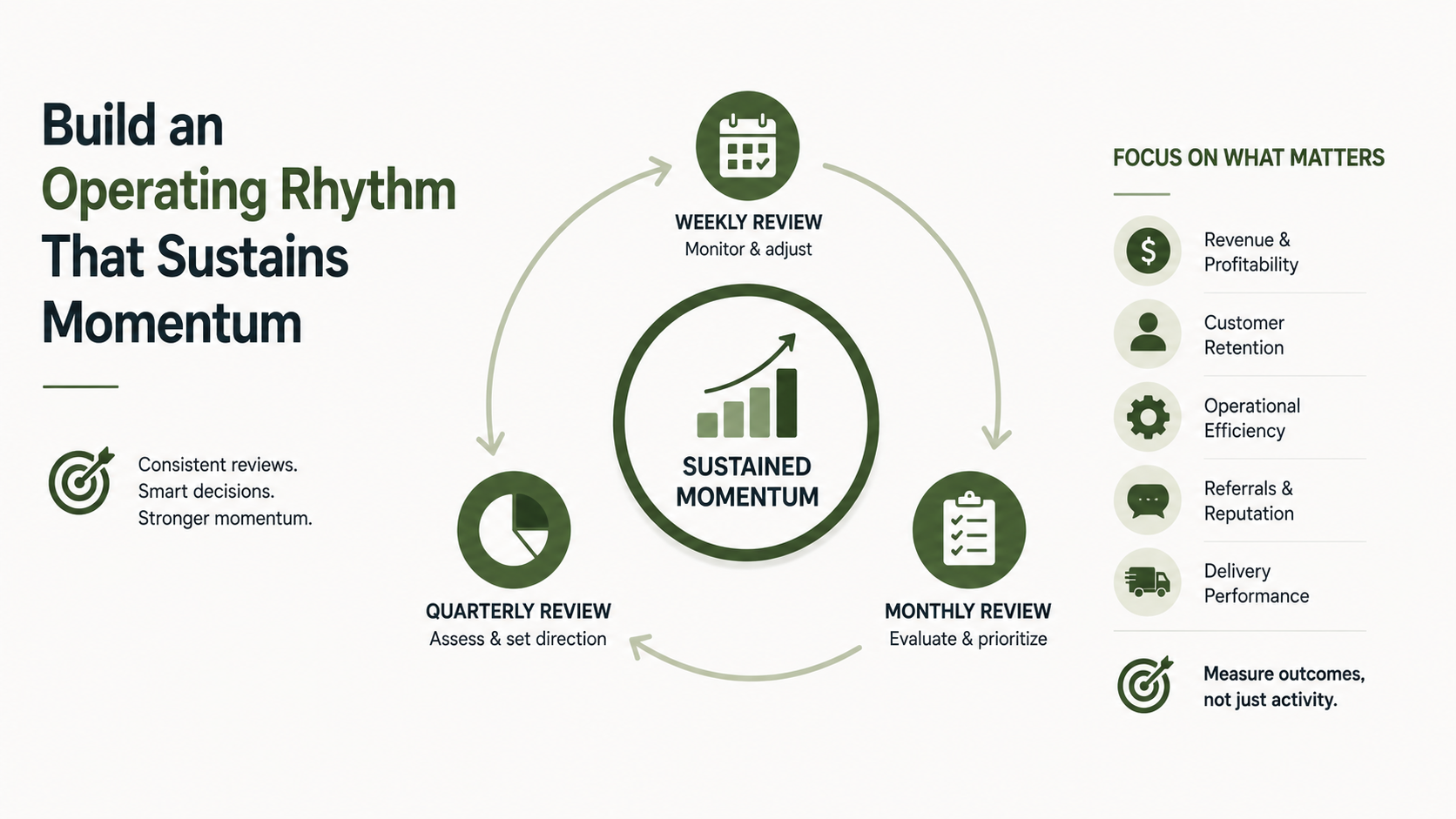
3. Build an Operating Rhythm That Sustains Momentum
Momentum is difficult to maintain without consistent review and disciplined execution. Businesses that continue improving establish regular weekly, monthly, and quarterly review cycles to monitor performance, evaluate progress, and adjust priorities when needed. These reviews should focus on meaningful business metrics such as revenue, profitability, customer retention, operational efficiency, referrals, and delivery performance rather than measuring activity alone.
As successful approaches emerge, they should be documented and standardized before the business expands further. Repeatable systems improve consistency, reduce errors, and make future growth easier to manage. Additional employees, technology, or capital should only be added after demand has been validated and successful processes are already in place. By combining structured reviews, evidence-based decisions, and repeatable systems, businesses create an operating rhythm that transforms focused effort into lasting momentum.
Conclusion
Businesses rarely regain momentum by simply doing more. More often, they move forward by identifying the single constraint that is limiting growth, concentrating resources on the highest-impact priority, and executing consistently until measurable progress is achieved. Focused priorities produce stronger execution, faster learning, and the small wins that build confidence over time.
Long-term momentum comes from disciplined systems, continuous improvement, and regular review rather than constant expansion. Businesses that simplify their priorities, strengthen what already works, and make decisions based on evidence create sustainable growth that continues building long after the initial breakthrough. The businesses that regain momentum fastest are those that focus less on staying busy and more on consistently doing the work that creates the greatest value.
FAQs
1: Why does my business feel stuck even when we're busy?
A business can feel stuck when activity is not producing measurable progress. Too many priorities, weak conversion, operational bottlenecks, or unclear positioning can keep teams busy without addressing the main constraint limiting growth.
2: How do I identify what is holding my business back?
Review the last 90 days and compare your activities with their actual results. Look for recurring problems in demand, sales, profitability, customer retention, operations, and leadership, then identify the single constraint that could create the greatest improvement if resolved.
3: How can I create momentum when growth has slowed?
Choose one measurable priority for the next 90 days and concentrate your resources on it. Break the goal into small, achievable actions, track meaningful indicators, and use the results to determine what should be repeated, improved, or stopped.
4: Should I focus on getting more leads when my business is struggling?
Not always. If the real problem is poor conversion, customer experience, pricing, or operational capacity, generating more leads may increase complexity without improving growth. First determine whether the business has a demand problem or a problem further along the customer journey.
5: How can I maintain momentum after business growth starts improving?
Create a consistent operating rhythm with weekly, monthly, and quarterly reviews. Track meaningful business metrics, standardize processes that work, and add people, tools, or capital only when evidence shows they are needed to support proven demand.