
Being highly capable is one of the greatest strengths a business owner can have, especially in the early stages of building a company. Founders often handle sales, operations, customer service, finances, and countless other responsibilities because doing so is necessary for survival. However, the skills that help a business get started can quietly become the very thing that limits its future growth.
Many leaders continue doing everything because they know they can, not because they should. As businesses grow, the value of a leader's time changes. Routine tasks, constant approvals, and day-to-day problem-solving may keep operations moving, but they often come at the expense of strategy, innovation, and long-term planning. Sustainable growth requires shifting from being the person who does everything to becoming the person who enables the business to thrive without depending on them.
1. The Competence Trap: When Doing Everything Starts Costing More
Being good at many roles can create a hidden trap. Because founders are capable of handling almost every responsibility, they naturally continue doing work that others could eventually take over. While this may feel productive, it creates an invisible opportunity cost. Time spent on administrative work, routine decisions, or repetitive operational tasks is time that cannot be invested in strategy, innovation, customer relationships, or business development.
The real question eventually changes from "Can I do this?" to "Should I be the one doing this?" Leadership is no longer about completing every task personally but about focusing on the work that creates the greatest long-term impact. Remaining involved in every detail also increases decision fatigue, making it harder to think strategically or identify new opportunities. What once felt like control gradually becomes one of the biggest barriers to growth.

2. How Founder Dependency Slows Business Growth
As businesses expand, relying on one person for every decision creates organizational bottlenecks. Every approval, customer issue, or operational question slows progress because the business can only move as quickly as its founder. At the same time, employees struggle to develop confidence and ownership when meaningful decisions always require someone else's approval.
This dependency affects both the business and its people. Innovation slows because ideas remain centralized, burnout increases as workloads continue growing, and talented employees have fewer opportunities to lead. Rather than building a stronger organization, the business becomes increasingly dependent on one individual's availability. Delegation changes this dynamic by empowering teams, improving decision-making, and creating the capacity needed for sustainable growth.
3. From Operator to Leader: Building Systems That Scale
One of the most important shifts in business is moving from operator to leader. Instead of spending every day solving immediate problems, leaders focus on setting direction, strengthening customer experiences, developing their teams, and improving the business for the future. This transition is not about working less—it is about creating greater impact through better decisions.
Delegation, strong systems, and clear processes make this possible. When responsibilities are supported by documented workflows, technology, and capable employees, the business becomes less dependent on constant founder involvement while maintaining consistent quality. Leadership also begins to look different. Success is measured not by how much work the founder completes personally, but by how effectively the organization performs as a whole.
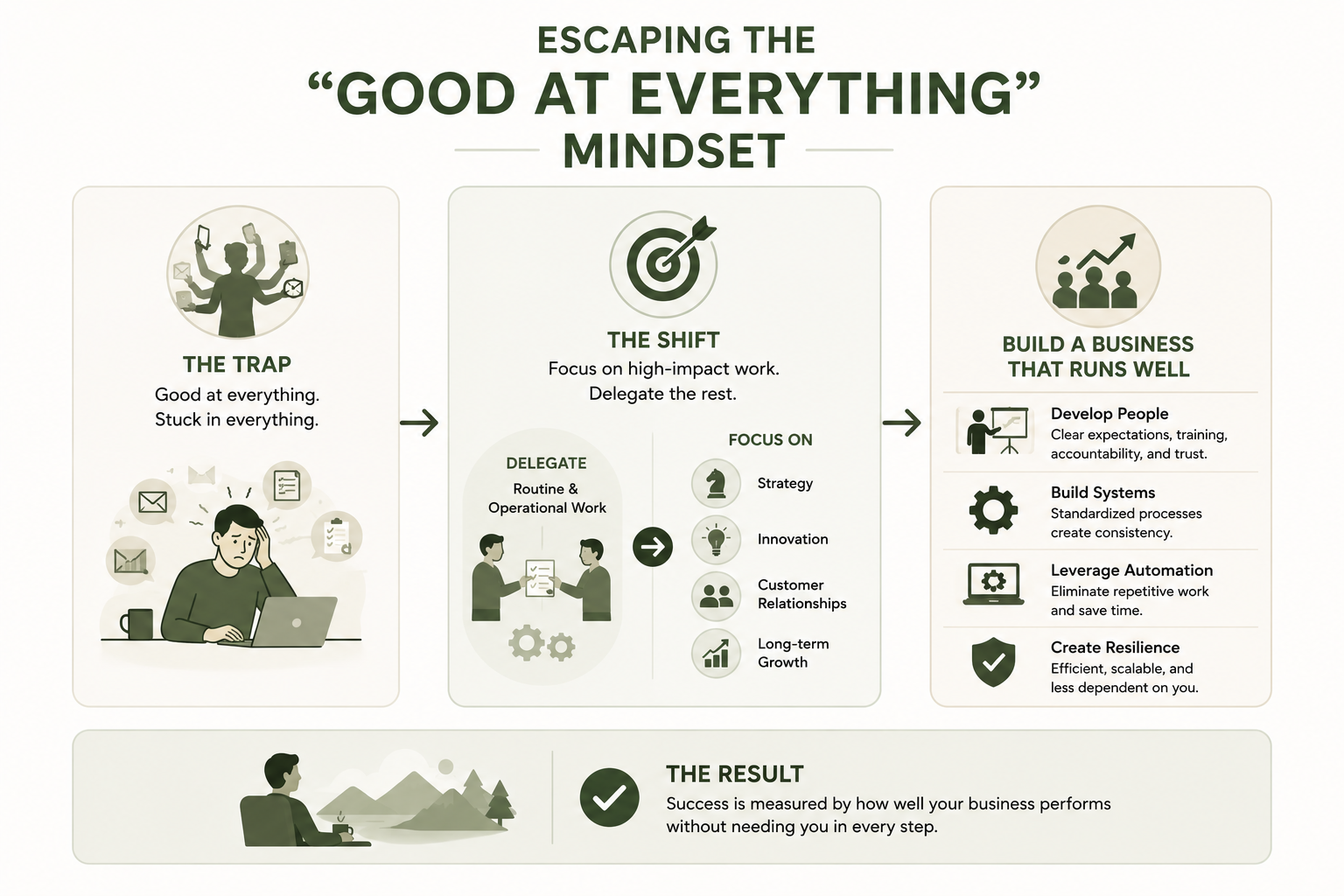
4. Escaping the "Good at Everything" Mindset
Growth comes from intentionally focusing on the work that creates the highest value. Instead of keeping every responsibility simply because they are capable, successful leaders delegate routine and operational work so they can concentrate on strategy, innovation, customer relationships, and long-term growth. The goal is not to do less—it is to spend time where leadership creates the greatest impact.
Developing people is just as important as delegating tasks. Clear expectations, accountability, training, and trust help employees build confidence and ownership while reducing dependence on the founder. Combined with reliable systems, standardized processes, and automation, businesses become more efficient, scalable, and resilient. Ultimately, success is no longer measured by how busy the founder is, but by how well the business performs without requiring constant personal involvement.
Conclusion
Being capable is a tremendous advantage, but trying to remain responsible for everything eventually limits both the leader and the business. Competence should create leverage, not dependency. The businesses that grow most successfully are those where leaders invest in strong teams, reliable systems, and clear strategic direction rather than carrying every responsibility themselves.
Delegation, operational excellence, and strategic focus create far greater long-term value than constant execution. When leaders empower others, build scalable processes, and concentrate on the work only they can do, the entire organization becomes stronger. The most successful businesses are not built by founders who do everything—they are built by leaders who create an environment where everyone can do their best work.
FAQs
1. Why is doing everything yourself bad for business growth?
Handling every responsibility may keep a business running in the early stages, but it eventually limits growth. When founders remain involved in every task and decision, they have less time for strategic planning, innovation, customer relationships, and leadership. Over time, the business becomes dependent on one person's capacity instead of building a team that can grow together.
2. How do I know when it's time to delegate?
A good indicator is when routine or operational tasks consume time that could be spent on higher-value activities. If your involvement is creating bottlenecks, delaying decisions, or preventing you from focusing on strategy and growth, it is likely time to delegate those responsibilities to capable team members.
3. What's the difference between being an operator and being a leader?
An operator focuses on completing day-to-day tasks and solving immediate problems, while a leader focuses on setting direction, building systems, developing people, and making strategic decisions. As a business grows, success depends less on personal execution and more on enabling others to perform effectively.
4. How can I delegate without losing quality or control?
Successful delegation relies on clear expectations, documented processes, training, and accountability rather than constant supervision. By creating reliable systems and supporting your team with the right tools and guidance, you can maintain consistent quality while reducing dependence on the founder.
5. What is the biggest benefit of moving beyond the "good at everything" mindset?
The greatest benefit is creating a business that can grow without relying on one person for every decision or task. Strong teams, scalable systems, and strategic leadership improve efficiency, reduce burnout, strengthen customer experiences, and position the business for sustainable long-term growth.