Why Cancellation Policy Is Not Optional
Every service provider will face cancellations. A client gets sick. An emergency comes up. Someone books on impulse and backs out. These situations are inevitable — and how you handle them financially and relationally defines both your income protection and your professional reputation.
The freelancers who handle cancellations poorly usually share one thing in common: they never built a clear policy before they needed one. When a cancellation arrives without a policy in place, you are forced to make a decision on the spot under social pressure — and most people, wanting to seem reasonable, default to giving a full refund even when that is not what their business can sustain.
A clear cancellation and refund policy does three things. It sets expectations before problems arise, so that clients who book understand the terms they are agreeing to. It removes the need for case-by-case decisions under pressure — the policy is the decision. And it protects the real cost of a cancelled appointment: your held time slot, which could have been filled by another paying client.
This article covers how to build a cancellation and refund policy that is fair, clear, and professionally enforceable — along with the templates, tools, and conversation scripts to implement it without damaging client relationships.
Understanding What a Cancellation Actually Costs You
Before setting a policy, it helps to understand what you are actually protecting. A last-minute cancellation is not just an appointment that did not happen — it is a specific set of losses:
- Lost revenue from the slot: The appointment time was reserved for that client. If cancelled last-minute, it is unlikely to be filled by another paying client.
- Preparation time: Many service providers spend time reviewing notes, preparing materials, or mentally preparing before a session. That time is not recoverable.
- Opportunity cost: Another prospective client may have wanted that slot and been turned away because it appeared full.
- Administrative time: Processing the cancellation, updating records, and potentially contacting a waitlisted client takes time.
Quantify this for your business: what does a single last-minute cancellation cost you? For a freelancer charging $150 per session with 2 cancellations per month, that is $300 in unprotected lost revenue — $3,600 per year. A deposit policy that retains 50 percent of that amount would recover $1,800 annually. That number makes the case for a strong policy more concretely than any general argument.
The Three-Tier Cancellation Policy Framework
The most widely used and client-accepted framework for service cancellation policies uses three tiers based on notice period. The windows should reflect how far in advance your clients typically book — a service booked days in advance needs shorter windows than one booked weeks out.
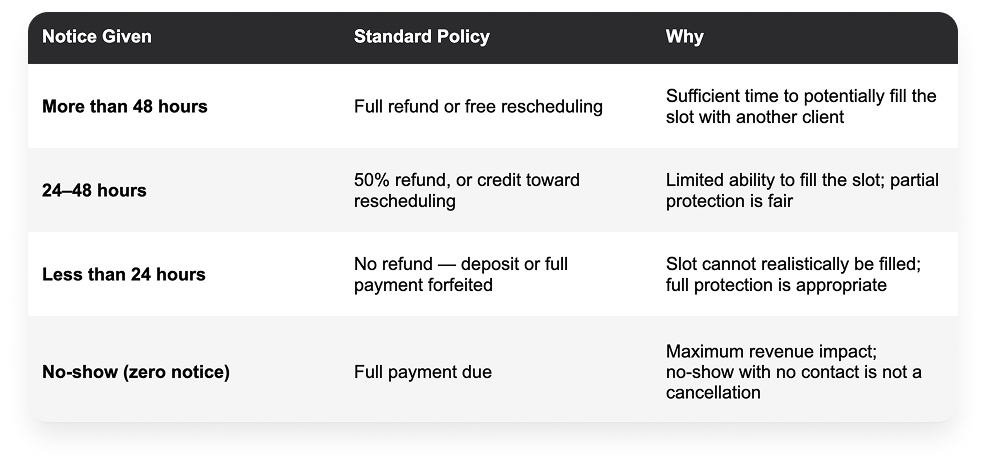
Adjust the windows for your service type. For services booked weeks in advance, a 5 to 7-day outer window is more appropriate. For services typically booked 1 to 2 days out, the 48-hour tier may be sufficient as the primary protection window.
The Rescheduling Option
Offering rescheduling as an alternative to cancellation is good practice at every tier. A client who reschedules keeps their money with you, stays in your pipeline, and often becomes a long-term client. Make rescheduling easy — a self-service rescheduling link in every confirmation and reminder email removes the friction and removes you from the coordination loop entirely.Most cancellations that happen within 24 hours are not deliberate — they are emergencies or oversights. Offering rescheduling rather than simply forfeiting the payment converts a potentially negative experience into a positive one and retains the client relationship.
Where to State Your Policy
A cancellation policy is only enforceable if it has been communicated clearly before booking. A policy added to an invoice after the fact is not binding. The policy needs to appear in at least two of the following places:
1. On Your Booking Page
State the key terms — deposit amount, cancellation window, and refund or forfeiture conditions — directly on your booking page before clients select a time. This ensures that every client who books has seen the terms. Book Like A Boss allows you to add custom text to your booking pages, making this straightforward to implement.
2. In Your Booking Confirmation
The automated confirmation email sent after booking should reiterate the cancellation terms. Keep it brief — two to three sentences that state the policy clearly and include the rescheduling link. By this point the client has already paid the deposit, so this is confirmation of terms they have already implicitly agreed to.
3. In Your Service Agreement
For ongoing client relationships, packages, or retainer arrangements, include your cancellation and refund terms explicitly in your written service agreement. The signed agreement creates a clear, written record of the terms both parties agreed to.
Stating your policy in one place is not enough. Clients who have seen it twice — on the booking page and in the confirmation email — have no reasonable basis for claiming they were not informed. Document the policy in at least two touchpoints and keep records of both.
Handling Cancellation Requests: Scripts and Templates
Even with a clear policy, cancellation conversations can feel uncomfortable. Pre-written response templates remove the friction of writing from scratch and keep your tone professional and consistent across every situation.
TEMPLATE 1: Cancellation Within Policy (Full Refund)
Subject: Re: Your cancellation request
Hi [Name],No problem at all — I have cancelled your appointment for [date/time] and a full refund of $[amount] has been processed. Please allow 5–10 business days for the refund to appear on your statement.I would love to reschedule when you are ready. You can book a new time here: [booking link]Best,[Your name]
TEMPLATE 2: Cancellation Within 24 Hours (Deposit Forfeited)
Subject: Re: Your cancellation request
Hi [Name],Thank you for letting me know. I have cancelled your appointment for [date/time].As noted in our booking terms, cancellations made within 24 hours of the appointment are non-refundable, so the deposit of $[amount] will not be returned. I understand this is not the outcome you were hoping for, and I appreciate your understanding.If you would like to rebook at a future date, I would be happy to help: [booking link]Best,[Your name]
TEMPLATE 3: Rescheduling Offer Response
Subject: Re: Rescheduling your appointment
Hi [Name],Absolutely — no problem at all. I have cancelled your [date/time] appointment. Since you are rescheduling, your deposit is being held and will be applied to your new booking.You can select a new time here: [booking link]Looking forward to speaking with you soon.[Your name]
TEMPLATE 4: No-Show Follow-Up
Subject: Missed appointment — [Date/Time]
Hi [Name],I wanted to check in as we had an appointment scheduled for [time] today that I did not see you at. I hope everything is okay.As a reminder, missed appointments without prior notice are charged in full per our booking terms. If you would like to reschedule, I am happy to do so: [booking link]Please feel free to reach out if anything came up.[Your name]
Handling Exceptions: When to Bend the Rules
A clear policy is the default. But real life produces situations where rigid enforcement damages the relationship more than the financial protection is worth. Here is a framework for deciding when exceptions are appropriate:
Genuine emergencies: A client hospitalized, dealing with a family bereavement, or facing a genuine crisis has not cancelled casually. Enforcing a forfeiture policy in these situations is legal but often not worth the relationship cost. Issue a full credit or refund and note it as an exception.
First cancellation from a long-term client: A client who has been with you for a year and books consistently cancelling for the first time is different from a repeat offender. One courtesy exception preserves the relationship; the policy applies from the second incident forward.
Ambiguity in the cancellation time: If a client cancels at 2am for a 10am appointment and the cancellation technically falls within your 24-hour window, using strict enforcement may feel disproportionate. Use judgment — the goal is fair protection, not extracting every possible dollar from edge cases.
Repeat offenders: A client who cancels frequently is a different conversation entirely — see the section on managing this pattern below.
Exceptions are legitimate business decisions, not policy failures. The key is that they are deliberate choices rather than defaults — you choose to waive the policy, you are not pressured into it by client pushback.
Managing Repeat Cancellers
Occasional cancellations are a normal part of service business. A client who cancels repeatedly — more than once every 2 to 3 months — is a different situation that requires a direct conversation.
The Direct Conversation
Address the pattern directly and professionally, without making it personal. The goal is to understand whether circumstances have changed and whether the appointment structure is still working for the client.
'I have noticed that we have had a few appointments that did not work out over the past couple of months. I want to make sure our arrangement is still working well for you — would it be helpful to revisit the scheduling or format of our sessions?'
This conversation does two things: it gives the client an opportunity to explain if circumstances have changed (a schedule change, financial difficulty, or a shift in needs), and it signals that you have noticed the pattern and it cannot continue indefinitely without addressing.
The Stricter-Terms Option
For clients with established cancellation patterns, moving to a full-prepayment-only arrangement is a reasonable response. State this calmly: 'Going forward, I will need full payment at the time of booking rather than a deposit, given our recent experience. I hope you understand.'
A client who accepts this has demonstrated they are committed. A client who declines has made the decision for you.
Refund Disputes and Chargebacks: How to Protect Yourself
A chargeback — where a client asks their card provider to reverse a charge — is the most serious financial risk in service business payment processing. A client who disagrees with your cancellation policy may escalate to a chargeback rather than accepting the terms they agreed to.
Prevention Is the Best Defense
- State your cancellation and refund policy clearly before booking and reiterate it in the confirmation email
- Keep records of all communications with the client including booking confirmations, policy statements, and any cancellation correspondence
- Use a booking platform that generates a paper trail — Book Like A Boss provides booking records, payment confirmations, and policy displays that can be referenced in a dispute
- Respond to cancellation requests promptly and document your response
If a Chargeback Is Filed
Most payment processors (Stripe, PayPal, Square) have a dispute resolution process where you can submit evidence to challenge the chargeback. Submit: a copy of your booking confirmation showing the policy terms, evidence that the cancellation occurred within the forfeiture window, records of any communication with the client about the cancellation, and screenshots of your booking page showing the policy was displayed.
Well-documented policies win the majority of legitimate disputes. The key is having the documentation before you need it, not scrambling to reconstruct it after a dispute is filed.
Frequently Asked Questions
What is a fair cancellation policy for a service provider?
A fair policy allows free cancellation or rescheduling with adequate notice — typically 48 hours or more — and applies forfeiture only when cancellations happen close enough to the appointment that the slot realistically cannot be filled. A tiered structure (full refund with 48+ hours notice, partial refund at 24–48 hours, forfeiture under 24 hours) is widely accepted as reasonable across service industries.
Can I keep a deposit if a client cancels?
Yes, if your policy clearly states that deposits are non-refundable for late cancellations and this policy was communicated to the client before they booked. A deposit is specifically designed to protect against this scenario. The policy must be stated clearly before the booking is made — not added after the fact.
How do I tell a client their deposit is non-refundable without damaging the relationship?
Apply the policy matter-of-factly rather than apologetically or defensively. Acknowledge the client's situation with genuine warmth, state the policy simply and without extended justification, and offer rescheduling as an alternative wherever possible. Most clients who booked through a professional system accept the policy when it is applied consistently and communicated warmly — problems arise when the policy feels like a surprise or an attack.
What happens if a client disputes a refund with their bank?
If you have documentation that the cancellation policy was communicated clearly before booking, that the client agreed to the terms by completing the booking, and that the cancellation occurred within the forfeiture window, you have strong grounds to contest the dispute with your payment processor. Submit this documentation promptly when the dispute is raised. Maintain records of all booking confirmations and policy statements as standard practice.
Should I have a separate policy for packages and single sessions?
Packages may warrant slightly different terms given the larger upfront commitment. A common approach: single sessions follow the standard tiered policy. Packages are non-refundable once started but any unused sessions can be transferred or converted to credit if the client needs to end the engagement early. State these terms separately in your service agreement for package arrangements.