The Invoice That Never Gets Paid
You finished the work. The client was happy. You sent the invoice. And then you waited. A week passed. Then two. You sent a polite follow-up. Nothing. You sent another. A vague reply about 'processing delays.' Now it has been six weeks, your invoice is gathering dust in someone's inbox, and you are stuck in the uncomfortable loop of deciding how hard to push without burning the relationship.
If this scenario sounds familiar, you are in very good company. Late payments are one of the most common and most demoralizing aspects of freelance life. Surveys of independent workers consistently show that the majority of freelancers have experienced late payment, and a significant portion have written off invoices entirely after failing to collect.
The real cost is not just financial. The mental overhead of tracking outstanding invoices, drafting follow-up emails, and managing the anxiety of unpaid work is exhausting. It occupies mental space that should be going toward client work and business growth.
Here is the good news: late payments are largely a systems problem, not a client problem. The right systems, policies, and tools dramatically reduce the frequency of late payment — and when it does happen, they make the follow-up process far less awkward and far more effective. This article walks you through every layer of those systems, from the structural changes that prevent late payment in the first place to the scripts that recover it when it occurs.
Why Late Payments Happen (And Why It Is Rarely About the Money)
Before building systems to prevent late payment, it helps to understand why it happens in the first place. Most late payments are not the result of clients deliberately avoiding their obligations. They fall into a few predictable categories:
- Invoice buried in inbox: Your invoice arrived, got read once, and was mentally filed under 'deal with later.' Later never came. This is the most common cause of late payment and the easiest to address with automated reminders.
- Unclear payment terms: If your invoice says 'Net 30' without context, some clients will interpret that as a suggestion rather than a deadline. Vague terms produce vague behavior.
- Friction in the payment process: If paying you requires the client to log into an unfamiliar portal, manually enter bank details, or navigate a clunky system, they will procrastinate. Every extra step between 'I need to pay this' and 'payment sent' increases the chance of delay.
- No upfront commitment: When clients pay nothing until the work is complete, they have no financial skin in the game. A client who has already paid a deposit is far more likely to complete payment — because they have already invested.
- Approval processes and payment cycles: Larger corporate clients often have internal approval chains that your invoice must pass through before payment is released. This is structural, not intentional — but knowing it in advance lets you build it into your expectations and contracts.
- Genuine cash flow problems: Occasionally, a client genuinely cannot pay right now. This is the least common scenario, but the most serious — and it is also the scenario that proper upfront payment policies protect against most effectively.
Understanding the cause shapes the solution. Most late payments can be prevented entirely with the right policies and tools. The remainder can be recovered quickly with the right follow-up system.
Layer 1: The Prevention — Collect Payment Before You Deliver
The most effective way to eliminate late payment is to change when payment happens. If clients pay before or at the time of booking — rather than after the work is delivered — the invoice chasing problem disappears entirely.
This sounds radical to freelancers who have always invoiced after completion, but it is the standard operating model for most service businesses outside of the freelance world. Your dentist collects payment at the appointment. Your hair salon charges when you leave. Your plumber takes a deposit before showing up. Service providers across every industry have recognized that getting paid after delivering the service puts all the financial risk on the provider — and it does not have to work that way.
Require a Deposit for Every Project
A deposit — typically between 25 and 50 percent of the total project value — accomplishes several things simultaneously. It filters out clients who are not serious. It gives you working capital to begin the project. It creates a financial commitment that makes final payment psychologically easier to collect. And it significantly reduces no-shows and last-minute cancellations.
Many freelancers worry that requiring a deposit will lose them clients. In practice, professional clients expect it. It is the clients who push back hardest on deposits who are most likely to create payment problems later.
Require Full Payment at the Time of Booking for Appointments
For service providers who charge per appointment — coaches, consultants, therapists, trainers, and similar — the deposit model can be taken a step further: require full payment at the time of booking. This is the cleanest solution to late payment because it means the invoice never needs to exist in the first place.
Book Like A Boss is built for exactly this model. When clients book an appointment through your BLAB page, they can be required to pay in full — or pay a deposit — before the booking is confirmed. The payment is collected through Stripe, PayPal, or Square, and the appointment is only confirmed once payment clears. No invoice. No chasing. No awkward conversations.
Structure Project Payments as Milestones
For longer projects where upfront payment in full is not realistic, structure payments around milestones rather than a single end-of-project invoice. A common model is:
- 25 to 50 percent deposit to begin the project
- 25 to 50 percent at a defined midpoint milestone
- Remaining balance upon final delivery or approval
Milestone payments reduce the financial risk at every stage and create natural checkpoints where both parties confirm the project is on track. They also mean that if payment stops, you stop working — limiting your exposure.
Layer 2: The Contract — Make Your Terms Impossible to Misunderstand
Every freelance engagement should be governed by a written agreement that clearly specifies payment terms. Not a vague email thread. Not a handshake. A document that both parties have reviewed and agreed to, which spells out exactly what is owed, when it is due, and what happens if it is not paid.
What Your Contract Should Include
- Exact payment amounts and due dates: Not 'Net 30' — instead, 'Payment of $X is due by [specific date].' Specific dates eliminate ambiguity.
- Late payment fees: A clause stating that invoices unpaid after the due date accrue a late fee — typically 1.5 to 2 percent per month — gives clients a financial reason to pay on time and gives you a legitimate basis for the additional charge if they do not.
- What happens to deliverables if payment is not received: For creative work, many freelancers include a clause that copyright and ownership of deliverables does not transfer until full payment is received. This is a powerful leverage point.
- Deposit and milestone payment schedule: Spell out exactly when each payment is due and what triggers it.
- Your right to pause or terminate work for non-payment: Include an explicit clause allowing you to pause work if a scheduled payment is not received. This protects you from continuing to deliver while a client falls further behind on payment.
If contract writing feels daunting, AI writing tools like ChatGPT or Claude can generate a solid first draft of a freelance contract based on your specific service type and terms. Always review carefully and, for significant contracts, have a legal professional check the final document before use.
Send the Contract Before You Begin — Always
A contract only protects you if it is signed before work starts. Sending it after the fact, or after a dispute has arisen, gives it much less legal and psychological weight. Make signing the contract a non-negotiable step in your onboarding process — nothing begins until it is signed.
Layer 3: The Invoice — Make It Easy, Clear, and Impossible to Ignore
Assuming you are doing project work where some payment comes after delivery, the invoice itself plays a significant role in whether it gets paid promptly. A professional, clear, easy-to-pay invoice gets paid faster than a vague, poorly formatted one.
Invoice Best Practices
- Invoice immediately upon completing the milestone or deliverable. Do not batch invoices at the end of the month. Send the invoice the same day or the next morning while the work is fresh in the client's mind.
- Use a specific due date, not a relative term. Write 'Due: March 20, 2026' not 'Due: Net 14.' Specific dates create a clear deadline.
- Include a direct payment link. Every invoice should have a single-click payment option. The easier you make it to pay, the faster you get paid. Remove every possible barrier between receiving the invoice and clicking 'pay.'
- Itemize clearly. Break down what each line item represents. A clear invoice signals professionalism and reduces the likelihood of a client questioning the total.
- Reference the contract and project scope. A brief note linking the invoice to the signed agreement removes any ambiguity about what is being billed.
Automate Invoice Delivery and Reminders
Invoicing platforms like FreshBooks, Wave, and QuickBooks allow you to set up automated payment reminders that go out at defined intervals without any manual effort. A typical sequence might look like:
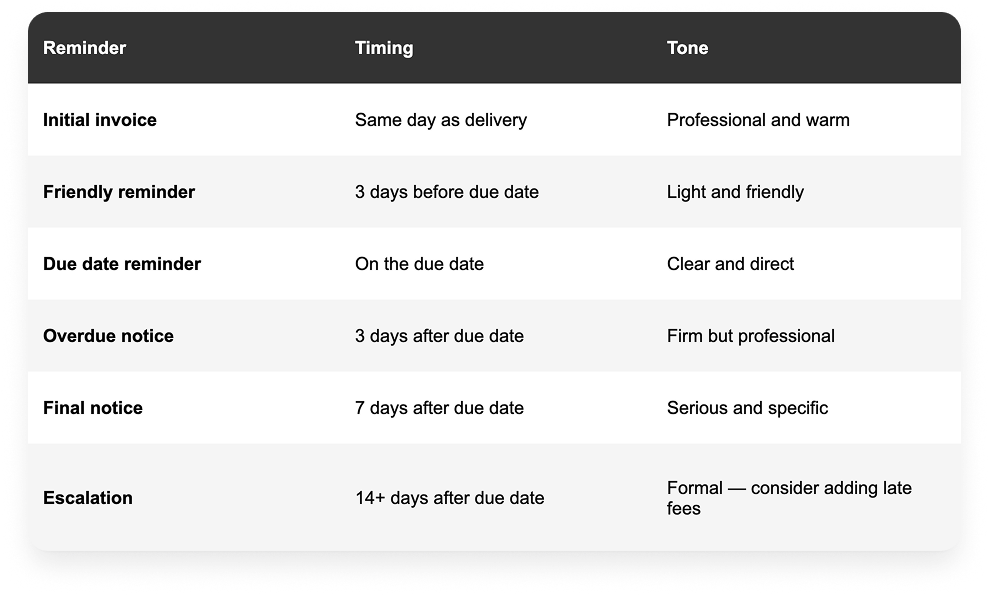
Once this sequence is configured, it runs automatically for every invoice. You do not have to remember to follow up, compose a follow-up email, or worry about the tone. The system handles it.
Layer 4: The Follow-Up Scripts — What to Say When Automation Has Not Worked
Even the best systems will occasionally encounter a client who does not respond to automated reminders. At that point, a personal follow-up is needed. The goal is to be clear and direct about the outstanding payment while maintaining a professional tone that does not burn the relationship.
Here are templates for each stage of the follow-up process. Adapt the tone and specifics to match your relationship with the client.
The Friendly First Follow-Up (3 to 5 days overdue)
TEMPLATE
Subject: Invoice #[NUMBER] — Quick Check-In
Hi [Client Name],I wanted to follow up on invoice #[NUMBER] for [project/service], which was due on [date]. I know things get busy — just flagging it in case it slipped through.You can pay directly here: [payment link]Let me know if you have any questions about the invoice.Best,[Your Name]
The Direct Follow-Up (7 to 10 days overdue)
TEMPLATE
Subject: Invoice #[NUMBER] — Now 7 Days Overdue
Hi [Client Name],Invoice #[NUMBER] for $[AMOUNT] is now 7 days past its due date of [date]. I have not yet received payment or heard back from you.Could you let me know when I can expect payment, or if there is an issue I should be aware of?Payment link: [link]Thank you,[Your Name]
The Firm Notice (14 days overdue)
TEMPLATE
Subject: Invoice #[NUMBER] — 14 Days Overdue — Action Required
Hi [Client Name],I am writing about invoice #[NUMBER] for $[AMOUNT], which is now 14 days past due. Per our agreement, a late fee of [X]% is now applicable.I need to receive payment — or a confirmed payment date — by [specific date]. If I do not hear from you by then, I will need to explore further options.If there is a specific issue preventing payment, please reach out so we can discuss a resolution.Payment link: [link][Your Name]
The Escalation Message (30+ days overdue)
TEMPLATE
Subject: Invoice #[NUMBER] — Final Notice Before Escalation
Hi [Client Name],Despite several attempts to contact you, invoice #[NUMBER] for $[AMOUNT] remains unpaid. The invoice is now [X] days past due, and the late fee has increased the total to $[AMOUNT WITH LATE FEE].This is my final notice before I pursue formal collection options. If payment is received by [specific date], I will consider the matter resolved.Payment link: [link][Your Name]
Note on tone: The scripts above escalate progressively from warm to firm. Each one assumes the previous messages have been sent and not responded to. Always keep a record of every message sent and every response received — this documentation is important if you need to pursue formal collection later.
Layer 5: When All Else Fails — Your Escalation Options
When a client is genuinely refusing to pay and personal follow-up has not worked, you have several escalation options. Understanding these in advance means you can act quickly and confidently rather than spending time researching options while money sits owed.
Small Claims Court
For invoices below a certain threshold — typically between $5,000 and $10,000 depending on your jurisdiction — small claims court is an accessible, relatively inexpensive option. You do not need a lawyer. Filing fees are modest. And the existence of a court judgment against them is a powerful incentive for clients to pay. The key requirement is documentation: your signed contract, all invoices, and all correspondence.
Freelance Unions and Associations
Organizations like the Freelancers Union in the United States offer resources and sometimes mediation support for members dealing with non-payment. Some jurisdictions have introduced freelancer protection laws — New York's Freelance Isn't Free Act being a notable example — that provide legal recourse and even the ability to recover attorney's fees in unpaid invoice cases.
Debt Collection Agencies
For larger unpaid invoices, a commercial debt collection agency can pursue payment on your behalf, typically in exchange for a percentage of the recovered amount. This is worth considering when the invoice is large enough that the agency's cut is still meaningful, and when you have exhausted direct follow-up options.
Publicly Posting Reviews
This option requires careful judgment, but leaving an honest review of your experience with a client on platforms like Trustpilot or relevant industry directories is a legitimate option. Do so factually, professionally, and only after all other avenues have been exhausted.
The Mindset Shift: You Are a Business, Not an Apologist
One of the most important — and least discussed — aspects of the late payment problem is the psychological barrier many freelancers face when it comes to asserting their right to be paid.
Many independent service providers feel a vague guilt about asking for money, even for work they have clearly delivered. They soften their language excessively. They apologize for following up. They wait far too long before escalating because they do not want to seem aggressive or damage the relationship.
Here is the reframe: getting paid is not aggressive. You provided a service. Payment is the other side of that transaction. Asking to be paid — firmly, professionally, and persistently — is not damaging the relationship. It is enforcing the professional standard that any legitimate business expects.
Clients who react badly to professional, reasonable payment follow-ups are telling you something important about how they treat their suppliers. That information is valuable. And clients who respect your professionalism — including your firmness about payment — are the ones worth keeping.
The freelancers who have the least trouble with late payments are almost always those who set the clearest expectations upfront, use automated systems for follow-up, and ask for money without apologizing for it. The awkwardness is usually in our heads — not in the professional exchange itself.
Building Your Anti-Late-Payment System: A Checklist
Use this checklist to audit your current payment setup and identify the gaps:
Prevention
- Require a deposit or full payment at the time of booking for all appointment-based services
- Use a booking platform that collects payment automatically — Book Like A Boss supports this natively
- Structure project-based work as milestone payments rather than a single end-of-project invoice
- Never begin work without a signed contract and received deposit
Contracts and Terms
- Every engagement has a written contract, signed before work begins
- Contract specifies exact payment amounts, specific due dates, and late fee policy
- Contract includes a clause about ownership of deliverables being contingent on full payment
- Contract gives you the right to pause work if a scheduled payment is not received
Invoicing
- Invoices are sent immediately upon completing each milestone or deliverable
- Invoices include a specific due date, a direct payment link, and clear itemization
- Automated payment reminders are configured in your invoicing software
- Invoice numbering and records are maintained for documentation purposes
Follow-Up
- You have follow-up email templates ready for each stage: friendly, direct, firm, and escalation
- Every follow-up communication is documented
- You have a clear personal policy for when you escalate and what that escalation looks like
Frequently Asked Questions
How do I ask for payment without sounding rude?
The key is to be direct without being aggressive. State the facts — the invoice number, the amount, the due date — and include a payment link. Avoid over-apologizing or softening your language to the point where the urgency is lost. A professional, matter-of-fact tone is not rude. Use the templates in this article as a starting point and adjust the language to match your natural communication style.
Should I charge late fees?
Yes, and you should specify them in your contract before the project begins. Late fees — typically 1.5 to 2 percent per month on the outstanding balance — serve two purposes: they incentivize on-time payment, and they compensate you for the time and cost of chasing invoices. Clients who see the late fee clause in the contract are more likely to pay on time. Clients who pay late face a legitimate consequence.
What is the best way to get paid upfront as a freelancer?
For appointment-based service providers, the cleanest solution is to collect payment at the time of booking using a tool like Book Like A Boss. Clients book their appointment and pay in the same flow — no invoice required. For project-based freelancers, requiring a 25 to 50 percent deposit before beginning work is the standard approach.
How long should I wait before following up on a late invoice?
Start the follow-up process as soon as the invoice is one day overdue. The longer you wait, the harder collection becomes — and the more the client's attention moves on to other things. Your automated reminder sequence should be configured to kick in immediately after the due date passes. Reserve personal follow-up for invoices that remain unpaid five to seven days after the due date despite automated reminders.
What do I do if a client says they cannot pay right now?
Ask for a specific date when they can pay, and get it in writing. If the amount is large, consider offering a structured payment plan — smaller amounts paid over a defined schedule — which can be easier for a cash-strapped client to manage while ensuring you receive the full amount. Document everything, continue to follow up on the agreed schedule, and if the commitment is repeatedly broken, escalate accordingly.
Can I stop work if a client has not paid?
Yes, if your contract includes a clause giving you that right — which it should. Pausing work due to non-payment is not unprofessional; it is a legitimate business protection. Notify the client clearly in writing that work is paused pending receipt of the outstanding payment, and specify what needs to happen for work to resume.
Is it worth taking a non-paying client to small claims court?
For invoices above a few hundred dollars where the client is clearly refusing to pay, small claims court is often worth pursuing. The filing process is accessible without a lawyer, fees are modest, and a judgment in your favor can be enforced in various ways including wage garnishment and bank levies. The key is having solid documentation: a signed contract, all invoices, and all correspondence.