
The Pricing Problem Most Freelancers Get Wrong
Pricing is one of the most difficult decisions in freelance life — and one of the most consequential. Set your rates too low and you work long hours for thin margins, attract clients who do not value your work, and struggle to build a sustainable business. Set them too high without the positioning to back it up, and you lose clients to more affordable alternatives.
Most freelancers set their rates one of two ways: by looking at what competitors charge and matching it, or by calculating what they need to earn and backing into an hourly or session rate. Both approaches have merit, but both also have significant blind spots that leave money on the table or create pricing that does not hold up under scrutiny.
This guide takes a more systematic approach. It covers the four factors that should inform every freelance pricing decision, the most common pricing models and when to use each, specific frameworks for calculating a minimum viable rate and a value-based rate, and the psychology of pricing — why raising your rates often improves both your income and the quality of your clients.
The Four Factors That Should Drive Your Pricing
1. Your Real Cost of Being in Business
Many freelancers price themselves without accounting for the full cost of being self-employed. Unlike a salaried employee, a freelancer pays for their own benefits, tools, taxes, and overhead — and not every hour is billable. Understanding your true cost baseline is the starting point for any rational pricing decision.
A simple calculation: take your desired annual take-home income, add your estimated annual business expenses (software, insurance, equipment, marketing), add your estimated self-employment tax liability, and divide by your realistic number of billable hours per year. This gives you your minimum hourly or session rate — the floor below which you are effectively losing money.
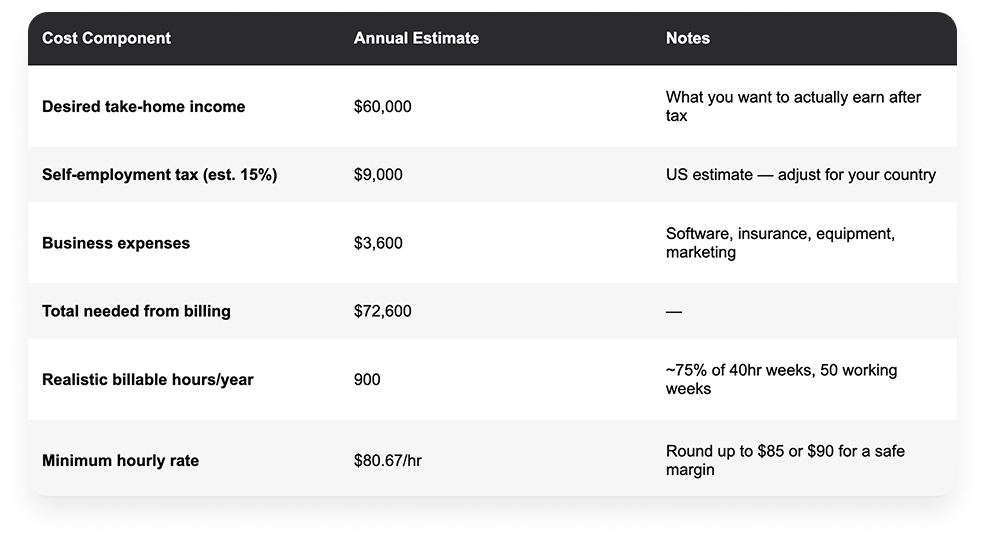
This is your floor — the rate below which you cannot sustain the business. Your actual rate should be above this, often significantly, based on the other factors below.
2. Market Rates for Your Service and Experience Level
Once you know your floor, research what the market pays for your specific service type, niche, and experience level. Market rates vary enormously by specialty, geography, and client type — a freelance web developer serving funded startups commands very different rates than one serving local small businesses.
Research sources include: industry salary surveys (Glassdoor, LinkedIn Salary), freelance platform rate data (Upwork, Toptal for high-end benchmarks), professional association reports, and direct conversations with peers in your field. The goal is not to copy market rates but to understand where you sit in the market and position accordingly.
3. The Value You Deliver to Clients
The most powerful pricing lever for experienced freelancers is not cost or market rate — it is value. A business coach whose clients increase revenue by $50,000 can charge far more than one whose clients merely feel inspired. A copywriter whose sales pages consistently convert at 5 percent is worth more than one who produces competent but undistinguished work.
Value-based pricing asks: what is the outcome of my work worth to the client? Not just what does the market pay for this service, but what does the specific result I deliver enable? When you can articulate and demonstrate the value of your outcomes, pricing becomes a conversation about ROI rather than a comparison of rates.
4. The Positioning You Want to Own
Your price is a positioning signal. A very low price signals that your service is a commodity. A premium price signals expertise, quality, and exclusivity. The clients you attract are partly a function of what you charge — premium clients expect to pay premium rates and are often skeptical of suspiciously low prices.
This does not mean higher is always better. But it does mean that your pricing should be intentional — aligned with the positioning you want to build and the clients you want to attract.
Pricing Models: Which One Fits Your Service?
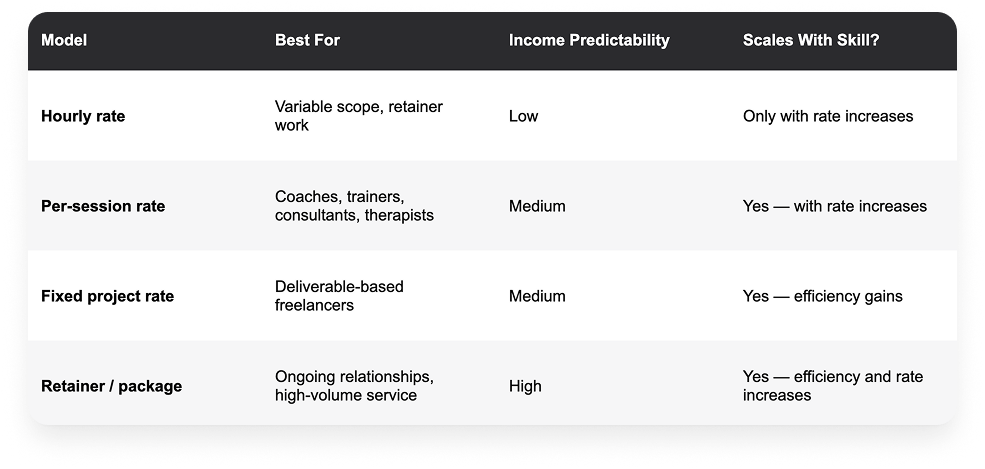
Hourly Rate
Charging by the hour is simple and familiar, but it has a significant structural flaw: it ties your income directly to your time, and punishes efficiency. The better you get at your work and the faster you deliver results, the less you earn per project — unless you raise your hourly rate continuously.
Hourly rates work best for: ongoing retainer work where scope is genuinely variable, exploratory or consultative work where the time required is hard to predict, and situations where the client specifically requires hourly billing for compliance or approval reasons.
Per-Session or Per-Appointment Rate
For service providers who deliver their value in defined sessions — coaches, consultants, trainers, therapists, tutors — a per-session rate is natural and clean. The client knows exactly what each appointment costs, making the buying decision simple. This model pairs naturally with booking platforms that collect payment at the time of booking.
The per-session model works best when sessions have a clear scope and consistent duration. It is less suited to service relationships where session length or content varies significantly.
Project-Based or Fixed Rate
Charging a fixed fee for a defined project scope aligns your incentive with the client's — they pay for the result, not the time. As you become more efficient, your effective hourly rate increases without requiring awkward rate conversations. Fixed-rate pricing requires clear scope definition upfront to avoid scope creep.
Retainer or Package
A fixed monthly fee for ongoing services or a bundled package of sessions at a slight discount from the per-session rate. Retainers provide income predictability for the freelancer and a defined engagement structure for the client. Most service providers should have at least one retainer or package option available alongside their per-session rate.
Calculating Your Rate: Two Approaches
Approach 1: The Cost-Plus Method
Start with your minimum viable rate (calculated above), add a margin for profit and growth, and arrive at a baseline rate. This ensures you never price below sustainability.
Example: minimum rate of $85/hour + 30% profit margin = $110/hour starting rate. Round to a clean number: $110/hour or $125/hour.
Approach 2: The Value-Based Method
Identify the tangible outcome your service delivers and price as a percentage of that value. A consultant who saves a client $200,000 in operational costs can justify a $20,000 fee — a 10 percent value share. A coach whose clients double their revenue in 6 months can charge significantly more than one whose clients report feeling 'more clarity.'
Value-based pricing requires: the ability to articulate specific, measurable outcomes; a client base where those outcomes are financially significant; and the confidence to have pricing conversations at that level. It is the most powerful pricing method for experienced freelancers but requires more preparation and positioning than cost-plus.
The practical approach for most freelancers: calculate your cost-plus floor, research market rates for context, and then set your rate above both based on the specific outcomes you deliver. Review and raise your rates at least annually.
Rate Benchmarks by Service Type
These are broad ranges based on market data for service-based freelancers in English-speaking markets. Rates vary significantly by geography, experience, niche, and client type. Use these as starting points for research, not as definitive guidelines.
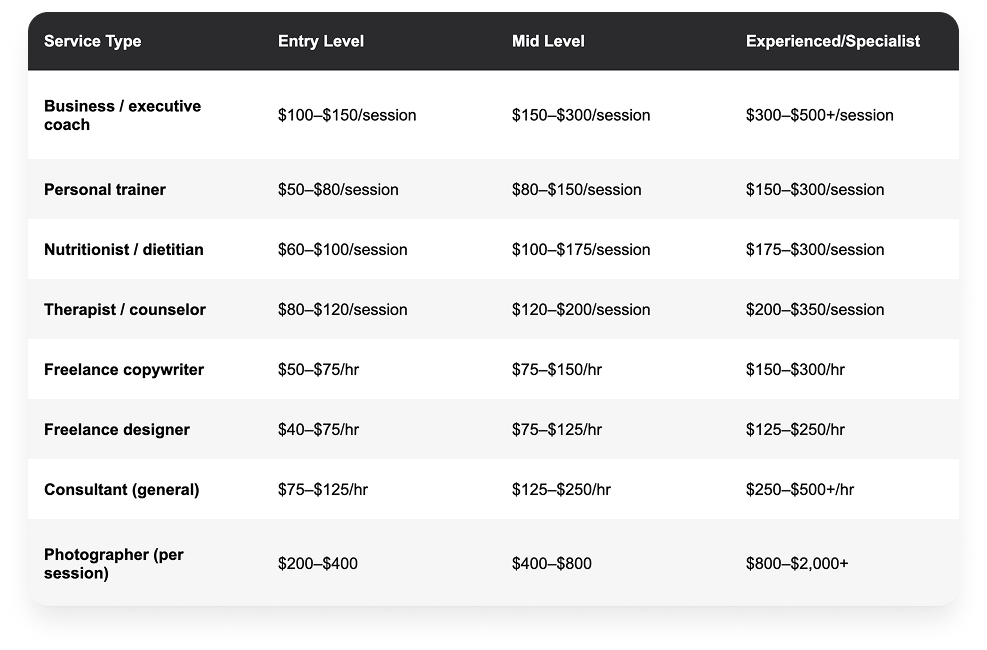
These ranges illustrate the spread between entry-level and specialist pricing. Moving from the lower to upper end requires a combination of: demonstrable results, a strong portfolio or testimonials, a clear niche or specialty, and the positioning to command premium rates.
The Psychology of Raising Your Rates
Most freelancers undercharge, and most know it. The barrier to raising rates is rarely financial logic — it is psychology. Fear of losing clients. Impostor syndrome. A vague sense that charging more requires permission from the market.
A few reframes that most freelancers find useful:
- A 20% rate increase rarely loses 20% of clients. Most clients who value your work will accept a reasonable rate increase, particularly if it is communicated professionally and with advance notice. You may lose a client or two — typically the most price-sensitive ones — and end up earning the same or more from fewer clients with better margins.
- Higher rates attract better clients. Premium-priced services tend to attract clients who are more committed, more respectful of your time, and more likely to follow through on the work. The correlation between low rates and difficult clients is not a coincidence.
- Undercharging is not generosity — it is a business problem. When you charge too little, you need more clients to reach your income targets, which means more time on administration, more context-switching, and less time for each individual client. Raising your rates often improves the quality of your work, not just your income.
How to Raise Your Rates on Existing Clients
Give existing clients 30 to 60 days advance notice. Frame the increase as a reflection of the value of the work rather than a cost increase. Acknowledge the relationship and express genuine appreciation for their continued engagement.
'I wanted to give you advance notice that my rates will be increasing from [current] to [new rate] effective [date]. I genuinely value our work together and wanted to make sure you had time to plan for this. Please let me know if you have any questions.' — Brief, professional, and respectful. No lengthy justification required.
Frequently Asked Questions
How do freelancers determine their hourly rate?
Start by calculating your minimum viable rate: add your desired take-home income, estimated taxes, and business expenses, then divide by your realistic billable hours per year. This gives you your floor. Set your actual rate above the floor based on market rates for your service type and experience level, and adjust upward as you build a track record of delivering measurable value.
Should freelancers charge by the hour or by the project?
Project-based pricing generally serves freelancers better than hourly billing for most types of work. It aligns your incentive with the client's — both parties want the result, not the time — and it rewards efficiency. As your skills improve and your work gets faster, your effective rate increases without requiring awkward conversations. Hourly billing makes more sense for genuinely variable-scope work where project pricing would require excessive contingency padding.
How do I know if my rates are too low?
Key signals that your rates are too low: you are consistently fully booked with no ability to raise prices, clients accept your quotes without negotiating (suggesting they expected to pay more), your income per hour worked is below your minimum viable rate, or you feel resentment toward clients or work because the compensation does not feel proportionate. If any of these apply, a rate review is overdue.
Is it okay to charge different rates to different clients?
Yes, within limits. Project-based pricing naturally varies by scope and client. Some freelancers charge different rates for different service types or client industries. What creates problems is charging different rates for identical services to clients who may compare notes — this is particularly common in close-knit industries or communities. As a general principle, transparency and consistency build the professional reputation that sustains rate increases over time.
How do I justify higher rates to clients?
Justification comes before the rate conversation, not during it. Your portfolio, testimonials, case studies, and the clarity with which you articulate your results are what justify your rates. By the time a prospective client is discussing price with you, they should already understand the value of what you deliver. If clients frequently push back on your rates, the problem is usually positioning rather than the rate itself.