
The Problem With One-Off Clients
There is a particular kind of exhaustion that comes with running a freelance business built entirely on one-off clients: the constant hustle of finding the next one. You deliver great work, the client is happy, and then they leave — and you start the acquisition cycle again. Every month begins with the same question: where is my income coming from this month?
One-off clients are not bad. They are often how relationships begin, and a single session can be genuinely valuable for both parties. The problem is building a business model that depends entirely on them. A roster of one-off clients means income that is perpetually unpredictable, a marketing machine that never stops, and a business where you are constantly starting over.
Recurring clients change the equation fundamentally. A client who books monthly generates predictable income, requires no re-acquisition cost, and typically becomes more valuable over time as the relationship deepens and the work gets better. The same hours that produced one session of income from a one-off client can produce ongoing monthly income from a retained one.
The shift from one-off to recurring does not require a different type of client or a different type of service. It requires the right offer structure, the right timing for the conversion conversation, and a booking system that makes recurring arrangements easy to manage. This article walks through all three.
Why Clients Stay One-Off (When They Do Not Have To)
Many clients who book a single session would happily book ongoing work — if they were offered it clearly and at the right moment. The reasons most one-off clients stay one-off have less to do with their needs and more to do with the freelancer's systems:
- No recurring offer exists: The freelancer only offers single sessions. There is nothing to upgrade to, so the client does not upgrade.
- The timing of the ask is wrong: A client is most likely to commit to ongoing work immediately after a great first session — when the value is fresh and the momentum is high. Waiting a week to follow up loses that window.
- The ongoing offer is not clearly articulated: Clients do not always connect the dots between a great single session and the potential for continued progress. The freelancer needs to make that connection explicit.
- The booking process for recurring work is unclear: If signing up for a package or retainer requires navigating an unclear process, many clients will default to booking single sessions even when they would prefer the convenience of ongoing arrangements.
Each of these is solvable with the right offer design and systems.
The Four Recurring Revenue Models for Service Providers
There is more than one way to structure recurring income as a service provider. The right model depends on your service type, typical client goals, and how you prefer to work. Here are the four most common and most effective:
Model 1: The Session Package
A bundle of sessions sold upfront at a slight discount to the per-session rate. The client pays once for a fixed number of sessions, usually delivered over a defined period (e.g., 4 sessions over 4 weeks or 8 sessions over 2 months).
Example: A business coach offers a 6-session package for $900 — a 10% discount on the $150 individual session rate. Payment collected upfront.
Setup tip: Create a Package service type in Book Like A Boss with the bundled price. Clients book and pay the full package amount in one transaction.
Model 2: The Monthly Retainer
The client pays a fixed monthly fee for a defined scope of service — a set number of sessions per month, a certain number of deliverables, or ongoing access. Payment recurs automatically each month.
Example: A nutritionist offers a monthly retainer: 4 x 45-minute sessions per month plus unlimited message support for $350/month.
Setup tip: Set up a recurring subscription service in Book Like A Boss, or use a tool like Stripe Billing for automatic monthly charges. Clients book individual sessions against their retainer allocation.
Model 3: The Membership or Subscription
Clients pay a regular fee (monthly or annually) for ongoing access to you or your services at a defined level. Common in coaching, consulting, and service businesses with a community or content component.
Example: A personal trainer offers a 'Priority Member' subscription at $200/month that includes 8 group sessions, unlimited booking priority, and a monthly check-in call.
Setup tip: Memberships can be set up as recurring bookings in Book Like A Boss or managed through a membership platform like MemberSpace or Kajabi.
Model 4: The Ongoing Project Retainer
For project-based freelancers, a monthly retainer for ongoing work — a set number of hours or deliverables per month at an agreed rate. The client pays monthly; the freelancer delivers consistent work without re-pitching each engagement.
Example: A copywriter offers a content retainer: 4 blog posts per month for $1,200/month, invoiced on the 1st of each month.
Setup tip: Pair with automated invoicing software (FreshBooks, Wave) for automatic monthly invoicing and payment reminders.
The One-Off to Recurring Conversion: Timing and Script
The best moment to convert a one-off client to recurring is immediately after a strong first session — when the client's experience of your value is at its highest and their motivation to continue is freshest. Waiting diminishes both.
The Conversion Conversation
This does not need to be a sales pitch. Frame it as a natural next step based on what you have just discussed in the session:
'Based on what we have covered today, I think you would get real traction if we worked together consistently over the next couple of months. I have a package that would be perfect for where you are — want me to send you the details?'
This approach works because it is genuinely helpful rather than pushy — you are connecting the value the client just experienced to a path toward more of it. Most clients who have had a positive first session will at least want to hear the details.
The Follow-Up Email
If the conversation does not happen during the session, send a follow-up email within 24 hours. Include:
- A brief summary of what was covered and the progress made
- A specific observation about what continued work could achieve for them
- A clear description of your package or retainer offer with pricing
- A direct booking link to purchase the package or schedule a follow-up conversation
The booking link in the follow-up email is critical. The easier you make it for a client to say yes — a single click to a page where they can book and pay — the higher your conversion rate. Book Like A Boss lets you create a dedicated booking page for each package type with a direct purchase link you can drop into any email.
Pricing Your Recurring Offers
Pricing packages and retainers involves balancing two considerations: the offer needs to feel like good value to the client, and it needs to be genuinely worth it to you.
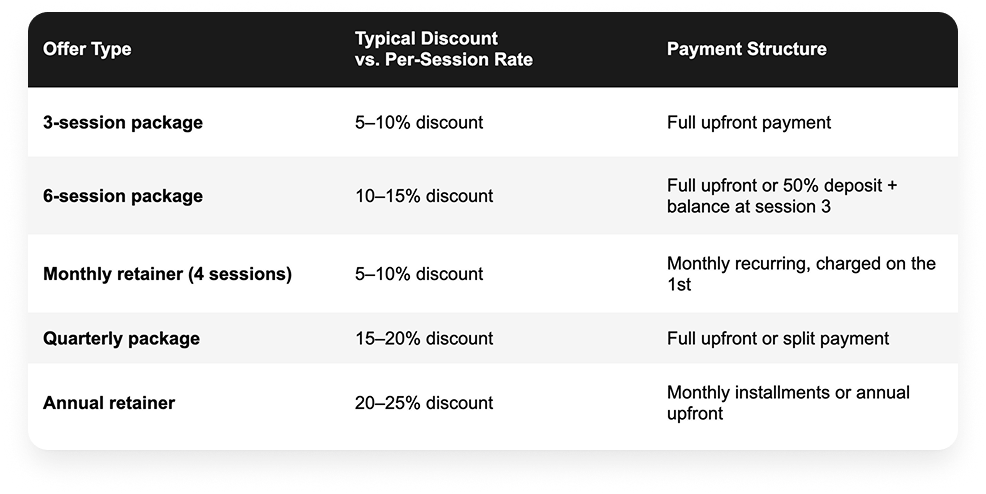
Discounts for packages and retainers serve two purposes: they make the offer financially attractive for the client, and they compensate for the reduced scheduling flexibility that comes with a committed engagement. The discount does not need to be large — many clients value the consistency and commitment of a package more than the price reduction.
The Predictability Premium
Many freelancers underestimate how much they personally benefit from recurring arrangements beyond the income itself. Predictable income reduces financial stress, allows better planning, and removes the constant marketing pressure to fill next month's calendar. This predictability has real value — value that justifies pricing packages at a modest discount rather than a steep one.
Making Recurring Arrangements Easy to Manage
Recurring clients are only better than one-off clients if they are easy to administer. A package or retainer arrangement that requires constant manual tracking, invoicing, and scheduling coordination can consume more time than it saves.
Scheduling
For clients on packages or retainers, standing appointment slots are the simplest arrangement. The same time every week or fortnight, booked in advance and recurring automatically. Book Like A Boss supports recurring booking configurations that handle this without manual rebooking each time.
Payment
For monthly retainers, automate the billing through a recurring payment setup — either through your booking platform or through a payment processor like Stripe Billing. The client's card is charged automatically on the same day each month. No invoice required. No follow-up needed.
Session Tracking for Packages
For session-based packages, keep a simple record of sessions used versus sessions remaining. Update it after each appointment and include the current status in your post-session follow-up email. Transparency about package usage builds trust and prompts timely renewals.
The Renewal: Keeping Clients Beyond the First Package
The best time to propose a package renewal is one session before the current package ends — not after it has expired. When a client is mid-engagement and getting value from the work, renewal is a natural conversation. When the package has already ended and the client has gone quiet, it is a re-acquisition problem.
Session before last: Mention that you have one session remaining and ask whether they would like to discuss continuing.
Final session: Review progress, acknowledge how far they have come, and present the renewal option as a natural next step.
Post-final session email: Send within 24 hours. Include a summary of achievements, where they could go from here, and a direct link to book the next package.
Clients who renew once are likely to renew repeatedly. The first renewal is the hardest — after that, continuity becomes the default and stopping becomes the active decision. Invest in making the first renewal as smooth as possible.
Frequently Asked Questions
How do freelancers get recurring clients?
The most effective approach is to create recurring offers — packages, retainers, or subscriptions — and present them to clients at the right moment: immediately after a strong first session. Most clients who have had a positive single-session experience are open to ongoing work if they are offered it clearly and with a straightforward way to commit. A direct booking link to your package page removes friction from the yes.
What is a good package structure for a service provider?
A three-session starter package at a 10 percent discount from the per-session rate is a low-barrier entry point for clients who are interested but not ready for a longer commitment. A six-session package at a 15 percent discount offers better value for clients who are ready to commit to a real engagement. Both should be available to book and pay directly from your booking page.
How do I price a monthly retainer?
Start with your per-session rate and calculate the cost of the sessions included in the retainer. Apply a modest discount — typically 5 to 15 percent — to reflect the value of the committed engagement to you and the convenience to the client. Add any additional retainer benefits (priority booking, between-session messaging, etc.) that justify the arrangement. Price the retainer so it feels like genuine value to the client while reflecting the real cost of your time.
How do I ask a client to continue working together without being pushy?
Frame the conversation around their progress and goals rather than around your need for continued income. What have they achieved? What is still ahead? What would continued work enable? When the conversation is focused on the client's journey, the offer to continue is a natural next step rather than a sales pitch. Most clients who have experienced real value from working with you will welcome the suggestion.
What happens if a client wants to pause their package?
Build flexibility into your package terms upfront: allow clients to pause for a defined period (typically one month) once per package, without forfeiting remaining sessions. Unlimited open-ended pausing, however, can create administrative complexity and revenue unpredictability. A clear, fair pause policy — stated in your service agreement — handles the exception without undermining the rule.