
Having more opportunities often seems like a clear sign that a business is moving in the right direction. New partnerships, product ideas, customer requests, and expansion opportunities can all create the impression that growth is accelerating. While these possibilities can certainly open new doors, pursuing too many of them at once often produces the opposite result. Instead of creating momentum, they divide attention, stretch resources, and make it increasingly difficult to execute any one initiative exceptionally well.
The challenge isn't a shortage of opportunities. It's deciding which ones deserve your time, investment, and focus. Every new project competes for the same limited resources, including your team's attention, budget, and operational capacity. Without clear priorities, businesses can become busy responding to opportunities without making meaningful progress toward their long-term goals.
Successful growth isn't determined by how many opportunities you pursue. It depends on how effectively you identify the opportunities that align with your strategy and execute them consistently. Understanding why opportunity overload happens can help businesses make better decisions, maintain focus, and achieve more sustainable growth.
1. Why Too Many Opportunities Can Create Less Progress
Having more opportunities may seem like a competitive advantage, but real growth involves two separate activities: selecting the right opportunities and executing them successfully. Identifying a promising idea is only the first step. Business results come from following through, measuring outcomes, and using those lessons to improve future decisions.
The problem begins when businesses spend more time saying yes than deciding whether they should. Every new market, product, partnership, or customer request may look valuable on its own. Together, however, they compete for the same people, budget, and operational capacity. Instead of concentrating effort on a few high-impact initiatives, businesses divide their attention across too many priorities.
This often leads to reactive decision-making instead of strategic planning. Leaders begin responding to whichever opportunity seems most urgent rather than evaluating which one best supports their long-term goals. Although this approach creates constant activity, it rarely creates meaningful progress.
There are also hidden costs to pursuing too many opportunities. Every additional initiative requires planning, communication, management, and execution. As commitments multiply, priorities become less clear, teams become stretched, and the quality of execution declines. Rather than accelerating growth, excessive opportunities can dilute effort and reduce the impact of the initiatives that matter most.
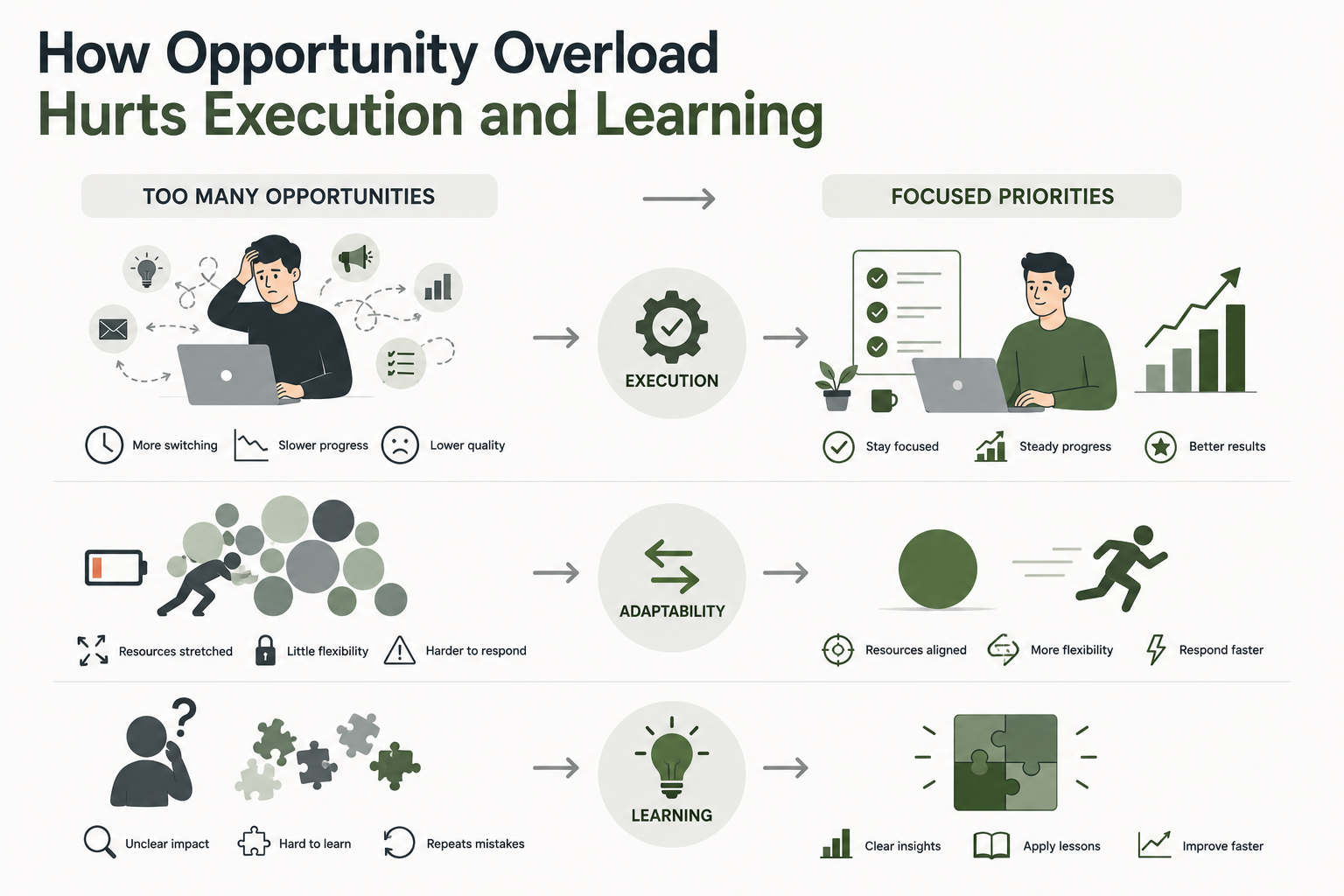
2. How Opportunity Overload Hurts Execution and Learning
Execution is where opportunities become business results. Even the strongest ideas require consistent attention to succeed. When priorities change too often, teams spend more time shifting between projects than completing them. Progress slows, quality becomes inconsistent, and it becomes harder to build momentum.
Opportunity overload also reduces adaptability. Businesses that concentrate on a smaller number of priorities can respond more effectively when challenges arise because their resources are focused on a clear objective. In contrast, organizations juggling multiple initiatives often have little flexibility left because their people and resources are already fully committed.
Learning also suffers when businesses constantly change direction. Every completed initiative provides valuable insights about customers, operations, and decision-making. When too many projects are running simultaneously, it becomes difficult to identify what contributed to success or failure. By pursuing fewer priorities, businesses can measure outcomes more accurately and apply those lessons to future opportunities.
3. Why Choosing Fewer Opportunities Leads to Better Growth
Sustainable growth comes from disciplined opportunity selection, not from pursuing every possibility. Successful businesses evaluate opportunities based on how well they support long-term objectives instead of chasing whatever appears most exciting or immediately profitable.
Rather than viewing every opportunity as an isolated win, strong businesses think in sequences. One carefully chosen initiative often builds the experience, credibility, customer relationships, or operational capabilities needed to unlock even greater opportunities later. This creates momentum that builds over time instead of relying on constant expansion.
Opportunity selection should also match the organization's capabilities. A promising idea may still be the wrong choice if the business lacks the people, systems, expertise, or financial resources to execute it effectively. Aligning opportunities with available capacity improves execution and reduces unnecessary complexity.
Strategic prioritization allows each successful initiative to strengthen the foundation for future growth. Instead of measuring success by the number of opportunities pursued, businesses benefit more from consistently completing initiatives that reinforce one another over time.
4. How Growing Businesses Can Stay Focused Without Missing Opportunities
As businesses grow, new opportunities naturally become more frequent. Staying focused does not mean ignoring them. It means evaluating each opportunity through a consistent decision-making process instead of reacting to whichever one appears first.
Creating clear evaluation criteria helps businesses compare opportunities objectively. Leaders should consider whether an opportunity supports long-term goals, strengthens existing capabilities, fits available resources, and creates value beyond short-term revenue. Having these standards in place reduces emotional decision-making and improves strategic consistency.
It is also important to distinguish between opportunities that are urgent and those that are genuinely important. Some opportunities demand immediate attention because they appear time-sensitive, while others generate lasting value even if they are not acted on immediately. Businesses that prioritize long-term impact are less likely to become distracted by short-term demands.
Finally, growth should be balanced with realistic capacity. Every new initiative requires time, funding, people, and operational support. Expanding faster than the organization can manage often creates unnecessary complexity that slows progress instead of accelerating it. Sustainable growth comes from executing a smaller number of high-impact opportunities exceptionally well.
Conclusion
Having more opportunities may seem like a clear indicator of business success, but opportunities alone do not create growth. Without careful selection and disciplined execution, they can increase complexity, dilute resources, and reduce a business's ability to deliver meaningful results. The companies that grow most consistently are not the ones that pursue every possibility. They are the ones that carefully select opportunities that align with their strategy and execute them exceptionally well.
By focusing on fewer, higher-impact opportunities, businesses can improve decision-making, strengthen execution, and build sustainable growth without becoming overwhelmed by endless possibilities.

FAQs
1. Why can having more opportunities slow business growth?
Having more opportunities can slow growth when businesses try to pursue too many at once. Dividing time, budget, and team resources across multiple initiatives often leads to weaker execution, unclear priorities, and slower progress than focusing on a smaller number of high-impact opportunities.
2. What is the difference between opportunity selection and opportunity execution?
Opportunity selection is the process of deciding which opportunities are worth pursuing based on your business goals and available resources. Opportunity execution is successfully carrying out those chosen opportunities. Long-term growth depends on doing both well, not simply identifying more opportunities.
3. How can businesses decide which opportunities to pursue?
Businesses should evaluate opportunities using clear criteria, such as alignment with long-term goals, potential customer value, available resources, and organizational capabilities. Prioritizing opportunities that support your overall strategy helps prevent distractions and improves the likelihood of successful execution.
4. Why is strategic focus important for business growth?
Strategic focus allows businesses to concentrate their resources on initiatives that deliver the greatest long-term impact. Instead of spreading efforts across multiple projects, focused businesses can execute more effectively, learn from results, and build momentum for future growth.
5. How can a growing business stay open to new opportunities without becoming overwhelmed?
Growing businesses can stay flexible by regularly evaluating new opportunities against predefined priorities rather than reacting to every possibility. Balancing growth ambitions with available resources and committing to fewer, high-value initiatives helps create sustainable growth without sacrificing execution quality.