


Client friction is anything that makes it harder than necessary for someone to understand, buy, use, or receive support for a product or service. It can come from repeated questions, unclear instructions, unnecessary forms, handoffs, long waits, or difficult contact options.
These obstacles may seem minor individually, but together they can make a client journey feel unnecessarily complicated. A process that looks simple internally may still require clients to make too many decisions, repeat information, or figure out what happens next.
The good news is that reducing friction does not require a complete redesign. Businesses can often create meaningful improvements by identifying a few high-impact obstacles and removing them one at a time. A clearer confirmation email, shorter form, better handoff, or useful status update can make an existing process significantly easier.
Customer Effort Score (CES) can also help businesses understand where clients are struggling. Instead of measuring satisfaction alone, CES looks at how easy it was for a client to complete a specific task or resolve an issue.
The goal is not to perfect every part of the client journey. It is to identify where unnecessary effort is creating the most difficulty and make practical, measurable improvements.
1. Find Where the Client Journey Creates the Most Effort
Before changing a process, businesses need to understand where friction actually occurs. Instead of trying to improve every touchpoint at once, start with one important, high-volume journey such as requesting a consultation, purchasing a product, requesting support, or renewing a contract.
Map the journey from the client's perspective. Look at what triggers the process, what information the client must provide, how many decisions they need to make, where delays occur, and where handoffs happen. Also consider what happens when something goes wrong. Can the client easily correct an error, find help, or continue without starting over?
Customer feedback can reveal friction that internal teams may not notice. Review support conversations, sales calls, surveys, and other client interactions for repeated questions, complaints, or areas of confusion.
Customer Effort Score can then help measure how easy specific interactions feel. Businesses can measure effort after support interactions, purchases, onboarding, form submissions, or other important client tasks.
The priority should be friction points that are frequent, painful, measurable, and practical to improve.

2. Remove Unnecessary Steps, Repetition, and Uncertainty
Once the biggest friction points are identified, look for unnecessary effort that can be removed without changing the entire process.
Repetition is one of the most obvious places to start. Clients should not have to provide the same information to multiple people or departments. Preserving conversation history, including issue summaries in handoffs, and using shared intake information can help clients feel like they are continuing one conversation rather than starting over.
Handoffs can create additional delays and confusion. Assigning clear ownership, using warm handoffs, and giving the receiving team member enough context can reduce the chance of lost information or contradictory answers.
Uncertainty is another major source of friction. Clients often become frustrated because they do not know what happens next, how long something will take, or whether they need to take action.
Make next steps specific. Instead of saying, "We'll be in touch soon," provide a timeframe. Instead of saying, "Your request is being processed," explain what is happening and when the client can expect an update.
Forms and instructions should also be reviewed regularly. Remove unnecessary fields, use plain language, provide clear headings, and organize information around the task the client needs to complete. The objective is not necessarily to provide less information. It is to make useful information easier to find and understand.
Finally, make contact options easy to find and provide useful status updates. When clients know what is happening and what they need to do next, they have less reason to send repeated follow-ups.
3. Make Every Interaction Easier and More Useful
Reducing friction is not only about removing steps. It is also about making each interaction more useful.
A response that answers only the immediate question may create another interaction when the client inevitably asks what happens next. Instead, businesses can anticipate likely follow-up questions and include that information from the beginning.
For example, a refund explanation can include when the money should appear. A project approval can include the files needed next. An account reset can explain what to do if the new login does not work.
This approach, sometimes called forward solving, helps clients move through the journey without repeatedly contacting the business for information they could have received earlier.
Language matters too. Internal terminology can create unnecessary cognitive effort when clients are unfamiliar with technical terms, department names, or internal processes. Review support tickets, sales conversations, reviews, and other customer communications to identify the language clients naturally use to describe their problems.
That language can then be reflected in website copy, proposals, onboarding messages, help content, and sales conversations.
Self-service can also make simple tasks easier, provided it does not become a barrier to human support. Clients should be able to find straightforward answers themselves while still having an accessible way to reach someone when an issue is more complicated.
Businesses should also avoid measuring success through speed alone. A fast but incomplete response may simply create another contact. Measures such as First Contact Resolution, repeat-contact rates, form completion, transfer rates, and Customer Effort Score can provide a better picture of whether the client actually reached the intended outcome.
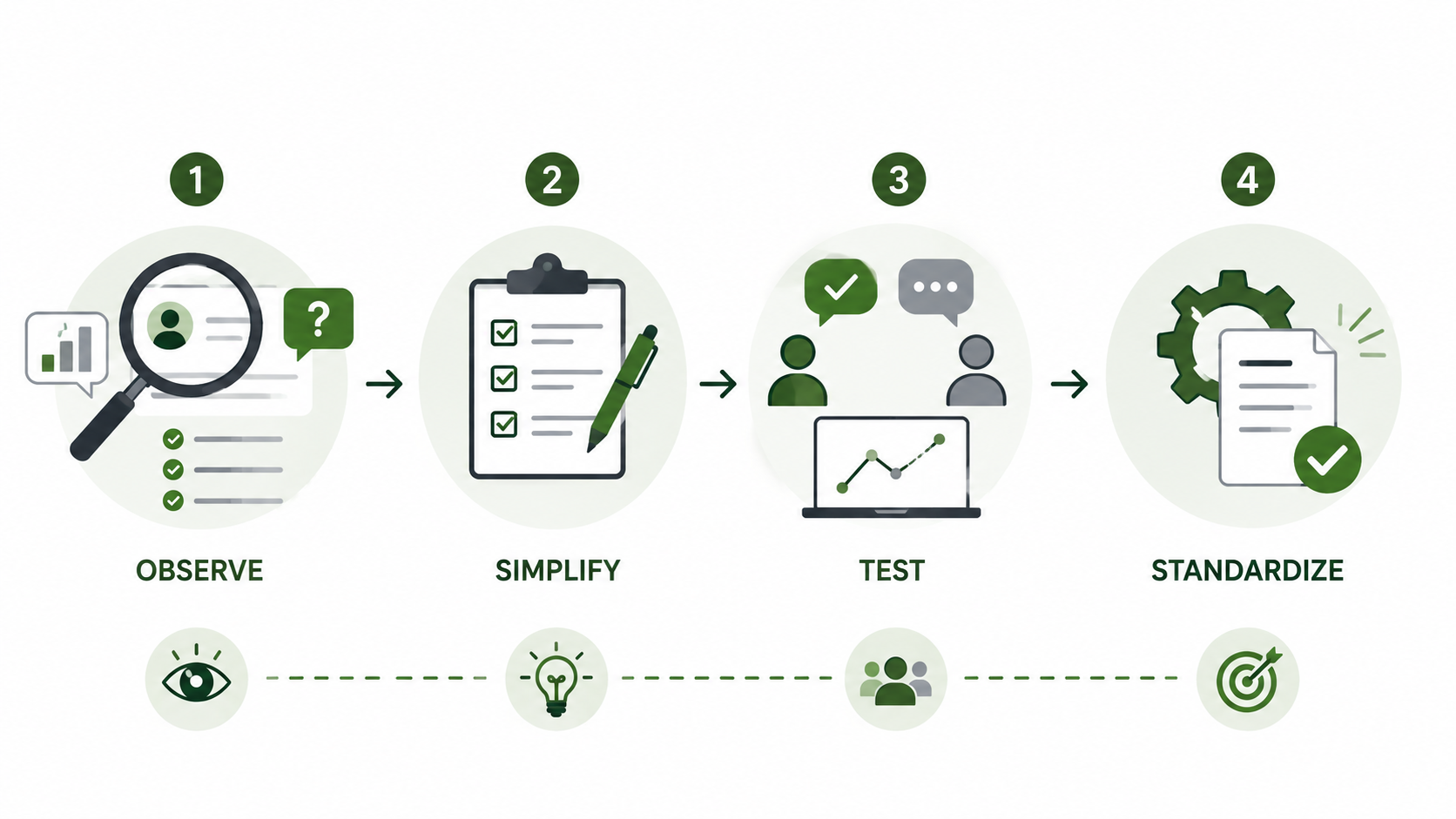
4. Test Small Changes and Build What Works Into the Process
Businesses do not need to launch a major customer experience project every time they discover friction. Small, controlled changes can often produce meaningful improvements while requiring little investment.
A simple 30-day process can help:
Week 1: Observe
Choose one important journey and review real client interactions. Identify repeated questions, delays, handoffs, confusing instructions, and unclear next steps. Establish a baseline using one or two relevant metrics.
Week 2: Simplify
Make targeted changes such as removing unnecessary form fields, rewriting instructions, improving confirmation emails, creating clearer handoff templates, or adding a more visible contact option.
Week 3: Test
Test the revised process with a small group and compare the results with the original experience. Ask clients what remained unclear and make adjustments based on what you learn.
Week 4: Standardize
If the change reduces effort or improves an important outcome, document it, assign ownership, and incorporate it into the normal process. Then move to the next high-impact friction point.
This approach also prevents businesses from automating a broken process. Technology can make a confusing process faster without actually making it easier. The research recommends identifying and mapping friction before introducing technology or AI as a solution.
Businesses should also avoid removing safeguards that exist for legitimate reasons such as privacy, compliance, quality, or financial control. The goal is to eliminate unnecessary effort, not useful protections.
Over time, these small improvements can become part of a repeatable system for improving the client experience.
Conclusion
Removing friction from the client journey does not require rebuilding the entire customer experience. Often, the most valuable improvements come from finding the small moments where clients repeat information, wait without updates, switch between channels, struggle with forms, or wonder what they are supposed to do next.
The most effective approach is to start with one important journey, examine it from the client's perspective, and identify the areas creating the most effort. From there, businesses can make targeted improvements such as preserving client context, reducing handoffs, simplifying instructions, clarifying next steps, improving status updates, and removing unnecessary form fields.
Measurement is important because a process change is only valuable if it actually improves the experience. Customer Effort Score, repeat-contact rates, First Contact Resolution, completion rates, and other relevant metrics can show whether the change reduced effort.
Ultimately, a smoother client journey is created through precision rather than transformation. Businesses do not always need more features, more technology, or a complete redesign. They often need to remove the obstacles that make an otherwise useful process harder than it needs to be.
FAQs
1. What is client friction?
Client friction is anything that makes it harder than necessary for a client to understand, purchase, use, or receive support for a product or service. Common examples include unnecessary forms, repeated questions, unclear instructions, delays, and difficult contact options.
2. How can I identify friction in the client journey?
Start by mapping one important, high-volume client journey from the client's perspective. Look for repeated questions, unnecessary decisions, delays, handoffs, unclear instructions, and points where clients struggle to complete a task. Customer feedback and Customer Effort Score can also help identify where effort is highest.
3. Do I need to redesign my entire client journey to reduce friction?
No. Many friction points can be addressed through small changes, such as simplifying forms, clarifying next steps, improving handoffs, providing better status updates, or preserving client information between interactions.
4. How does Customer Effort Score help reduce client friction?
Customer Effort Score (CES) measures how easy or difficult it was for a client to complete a specific task or resolve an issue. Measuring CES at important points in the journey can help businesses identify where clients are experiencing unnecessary effort.
5. What is the best way to test changes to the client journey?
Start with one high-impact friction point and make a small, controlled change. Test it with a limited group, measure results such as repeat contacts, First Contact Resolution, form completion, or Customer Effort Score, and standardize the change if it improves the experience.


