.webp)
Many businesses invest heavily in driving traffic to their website but still struggle to generate actual inquiries, bookings, or sales. They improve SEO rankings, run ads, post consistently on social media, and successfully attract visitors — yet conversions remain low. This creates frustration because high traffic can make a website appear successful even when very few visitors actually become leads.
The problem is that attracting attention and converting visitors are two very different things. A website may succeed at getting clicks while failing to persuade people to take action. Visitors become leads only when the website clearly communicates value, builds trust, reduces uncertainty, and guides them toward an easy next step.
Many websites quietly lose potential customers because of problems that seem small but create major friction in the user experience. Weak messaging, unclear calls-to-action, confusing navigation, slow-loading pages, and missing trust signals often cause visitors to leave before fully understanding the offer. In many cases, businesses assume the problem is lack of traffic when the real issue is poor conversion performance.
This is why conversion-focused websites are built differently. Instead of simply attracting visitors, they are intentionally designed to guide users toward action. Every headline, page section, trust signal, and call-to-action works together to reduce friction and make the next step feel clear, valuable, and low-risk.
1. Weak Messaging and Poor Targeting Confuse Visitors
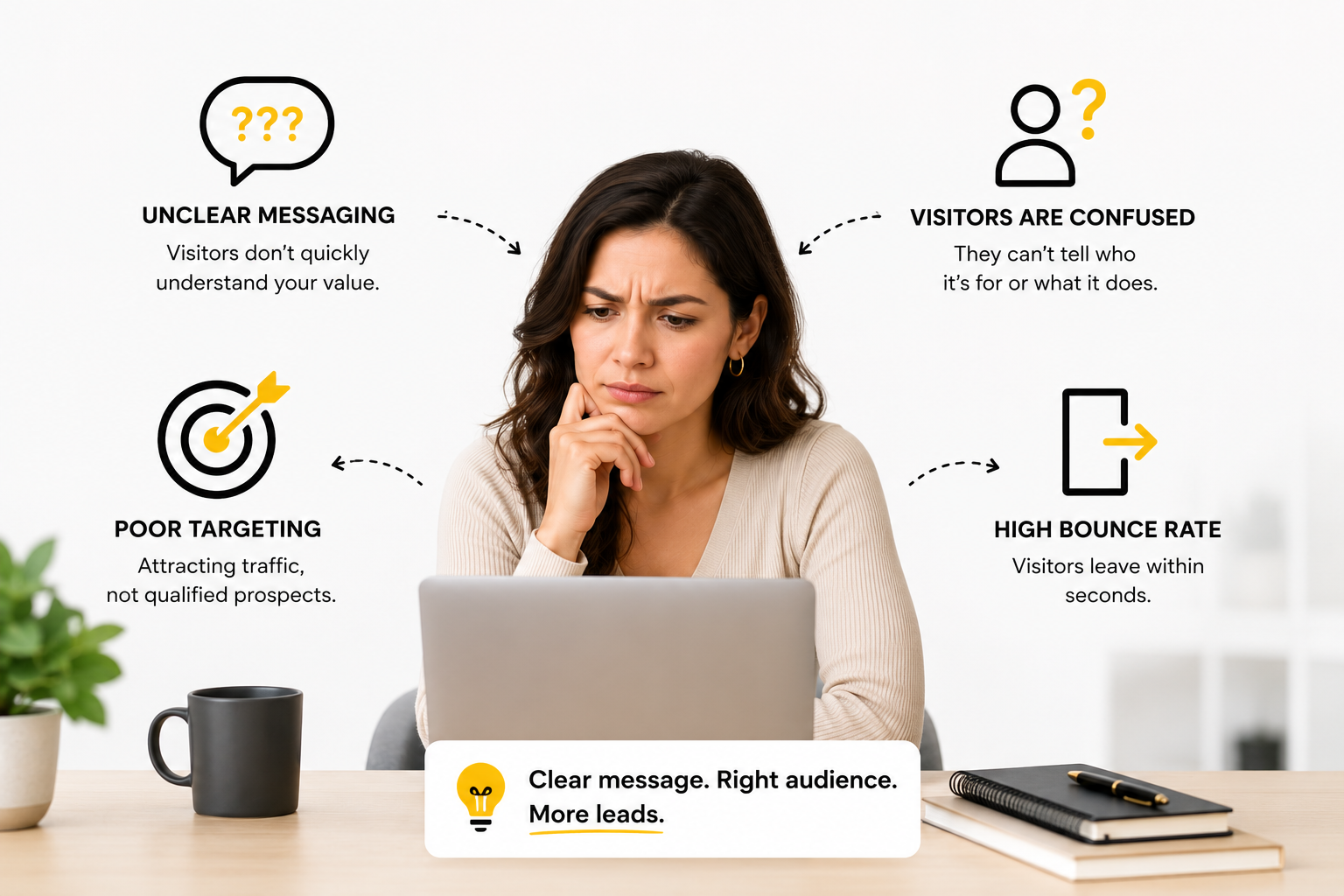
One of the biggest reasons websites fail to generate leads is unclear messaging. When visitors land on a website, they immediately try to answer a simple question: “Is this relevant to me?” If the value proposition feels vague, generic, or difficult to understand, most people leave within seconds without exploring further.
Online attention spans are extremely short, and visitors rarely spend time trying to figure out what a business actually does. Broad statements like “Helping Businesses Grow” may sound professional, but they often fail to communicate clear value. Without specificity, visitors struggle to understand who the service is for, what problem it solves, or why they should care.
Generic messaging also weakens buyer intent because it tries to appeal to everyone. Strong websites focus on specific outcomes instead of vague descriptions. Messaging such as “Generate More Qualified Leads in 90 Days” creates stronger engagement because visitors immediately understand the value being offered.
Targeting matters just as much as messaging. There is a major difference between attracting traffic and attracting qualified prospects. A website may receive thousands of visitors, but if those visitors are not actively searching for the solution being offered, conversions remain low. Attention alone does not create leads when visitor intent and messaging are misaligned.
Ultimately, websites generate more leads when they attract the right audience and communicate value quickly enough to keep visitors interested long enough to take the next step.
2. Unclear CTAs and Friction Stop Visitors From Taking Action
Even interested visitors often fail to convert because the next step feels unclear, confusing, or unnecessarily difficult. A website may provide useful information and attractive design yet still lose leads simply because users do not know what action they are supposed to take next.
This is where calls-to-action become critical. Every page should guide visitors toward one clear next step, whether that is booking a call, requesting a quote, downloading a guide, or sending an inquiry. When websites present too many competing options or unclear instructions, visitors lose momentum and leave without taking action.
Confusing layouts and poor navigation create additional friction. Visitors should not have to search through cluttered menus or multiple pages just to understand how to contact the business. When important information is difficult to find, users become frustrated and abandon the process before converting.
Long forms also increase drop-offs significantly. Many businesses ask for too much information too early, making the process feel overwhelming and time-consuming. Every additional field increases the chance that visitors postpone the action or leave entirely.
Frictionless booking systems and simple forms help maintain conversion momentum because they reduce effort and uncertainty. Short forms, clear buttons, instant booking options, and straightforward instructions make the process feel faster and easier to complete.
Ultimately, websites convert more effectively when they reduce friction and clearly guide users toward the next step. The easier the experience feels, the more likely visitors are to become leads instead of quietly leaving the site.
3. Weak Trust Signals and Poor User Experience Reduce Credibility
Even strong messaging and clear calls-to-action are often not enough to generate leads if visitors do not trust the business. Before people submit personal information or schedule a consultation, they want reassurance that the company feels legitimate, credible, and capable of delivering results.
Testimonials, reviews, and case studies play a major role in building confidence. Potential customers naturally look for proof that other people have already worked with the business successfully. Positive reviews and detailed testimonials reduce skepticism because they provide evidence that real clients achieved positive outcomes.
Trust signals are especially important online because visitors cannot physically interact with the business. Companies without reviews, recognizable client logos, or visible success stories often appear riskier, even if their service quality is excellent.
Website performance also strongly influences credibility. Slow-loading pages, outdated designs, broken layouts, or poor mobile experiences immediately weaken trust because they make the business appear less professional and less reliable. Visitors often interpret poor website performance as a sign that the company may also be disorganized in other areas.
Visible trust signals placed near calls-to-action can significantly improve conversions because they reduce perceived risk at the moment visitors are deciding whether to take action. A short testimonial, review badge, or client logo near a booking form helps reassure users that the business is trustworthy.
Ultimately, strong websites combine polished user experience with visible credibility signals to create confidence before the visitor ever speaks to a representative.
4. Websites Lose Leads When Follow-Up Systems Are Missing
Many businesses assume that once a visitor fills out a form or downloads a resource, the website has successfully done its job. In reality, capturing contact information is only the beginning of the conversion process. Without proper follow-up systems, many leads lose interest or move on before any meaningful conversation happens.
This happens because most website visitors are not ready to buy immediately. Many people are still researching, comparing options, or trying to better understand their problem before making a decision. Even highly interested visitors may leave without taking action simply because they need more time, trust, or information before committing.
Lead magnets help solve this problem by creating value before the sale. Helpful resources such as checklists, templates, guides, or educational content encourage visitors to exchange their contact information for something useful and relevant.
However, lead magnets alone are not enough. Without nurture sequences and consistent follow-up, many new leads quickly go cold. Businesses often lose potential customers simply because there is no system keeping the relationship active after the initial interaction.
Automated follow-up systems help maintain momentum by continuing the conversation after visitors leave the website. Welcome emails, educational content, testimonials, case studies, and booking invitations all help strengthen trust gradually over time.
The most effective websites are designed not only to attract visitors, but also to continue nurturing them after the initial interaction. Businesses generate more leads when they create systems that turn attention into ongoing engagement instead of relying entirely on immediate conversions.
Conclusion — High-Converting Websites Guide Visitors Toward Confidence and Action
Many websites fail to generate leads not because they lack traffic, but because they fail to guide visitors toward action clearly and confidently. Attracting attention is only the first step. Conversions happen when websites successfully persuade, reassure, and reduce hesitation throughout the user experience.
Strong messaging helps visitors quickly understand the value being offered and whether it is relevant to their needs. Clear calls-to-action guide users toward the next step without confusion or friction. Trust signals such as testimonials, reviews, and case studies reduce skepticism while increasing confidence in the business. Fast-loading pages, simple navigation, and smooth user experience help maintain momentum instead of creating frustration that pushes visitors away.
Follow-up systems also play a critical role because most visitors are not ready to convert immediately. Lead magnets, nurture emails, and automated follow-up sequences keep potential customers engaged long enough to build familiarity, trust, and readiness over time.
Ultimately, successful websites do far more than simply look good. They are carefully designed to reduce confusion, hesitation, and uncertainty at every stage of the customer journey. The easier a website makes it for visitors to understand the value, trust the business, and take the next step, the more effectively it turns traffic into real leads and conversations.
FAQs
1. Why is my website getting traffic but not generating leads?
Your website may be attracting visitors but failing to convert them because of unclear messaging, weak calls-to-action, poor user experience, or missing trust signals. Traffic alone does not create leads if visitors do not understand the value or feel confident taking the next step.
2. How do I know if my website messaging is hurting conversions?
If visitors leave quickly, spend very little time on your pages, or rarely inquire despite high traffic, your messaging may be too vague or generic. Strong messaging should clearly explain who you help, what problem you solve, and what results customers can expect.
3. What makes a website convert visitors more effectively?
High-converting websites combine clear messaging, strong trust signals, simple navigation, fast-loading pages, and obvious calls-to-action. They reduce friction and make it easy for visitors to understand the value and take action confidently.
4. Why are trust signals important for lead generation?
Visitors are more likely to become leads when they feel the business is credible and reliable. Testimonials, reviews, case studies, client logos, and professional website design help reduce skepticism and increase confidence before someone submits an inquiry or books a call.
5. Can follow-up systems really improve website conversions?
Yes. Most visitors are not ready to convert immediately. Follow-up systems such as email nurture sequences, lead magnets, reminders, and educational content help businesses stay visible while gradually building trust and encouraging prospects to take action later.