
Many business owners assume that growth will eventually make running their business easier. They imagine that more employees, higher revenue, better technology, and larger teams will naturally reduce their workload and simplify operations. While growth creates new opportunities, it also introduces increasing complexity. As organizations expand, they must coordinate more people, manage more customers, oversee additional products or services, and make increasingly important decisions. Without clear direction, that complexity quickly becomes a source of confusion rather than progress.
Every stage of growth adds new moving parts. Communication becomes more difficult, responsibilities become more specialized, and decisions involve more stakeholders. Processes that worked well for a small business may no longer support a larger organization. As priorities multiply, departments can drift in different directions, creating inconsistent messaging, duplicated work, and slower execution. Growth rarely creates problems by itself, but it magnifies weaknesses that were previously manageable.
This is why clarity becomes increasingly valuable as a business grows. Clear priorities, shared goals, and well-defined decision-making help every team understand what matters most and how their work contributes to the company's success. Businesses rarely struggle because they lack ambition, they struggle because complexity begins growing faster than clarity. Sustainable growth depends on making direction, priorities, and decision-making clearer as the business becomes more complex, allowing every part of the organization to move toward the same objective with confidence.
1. Why Growth Without Clarity Creates Friction
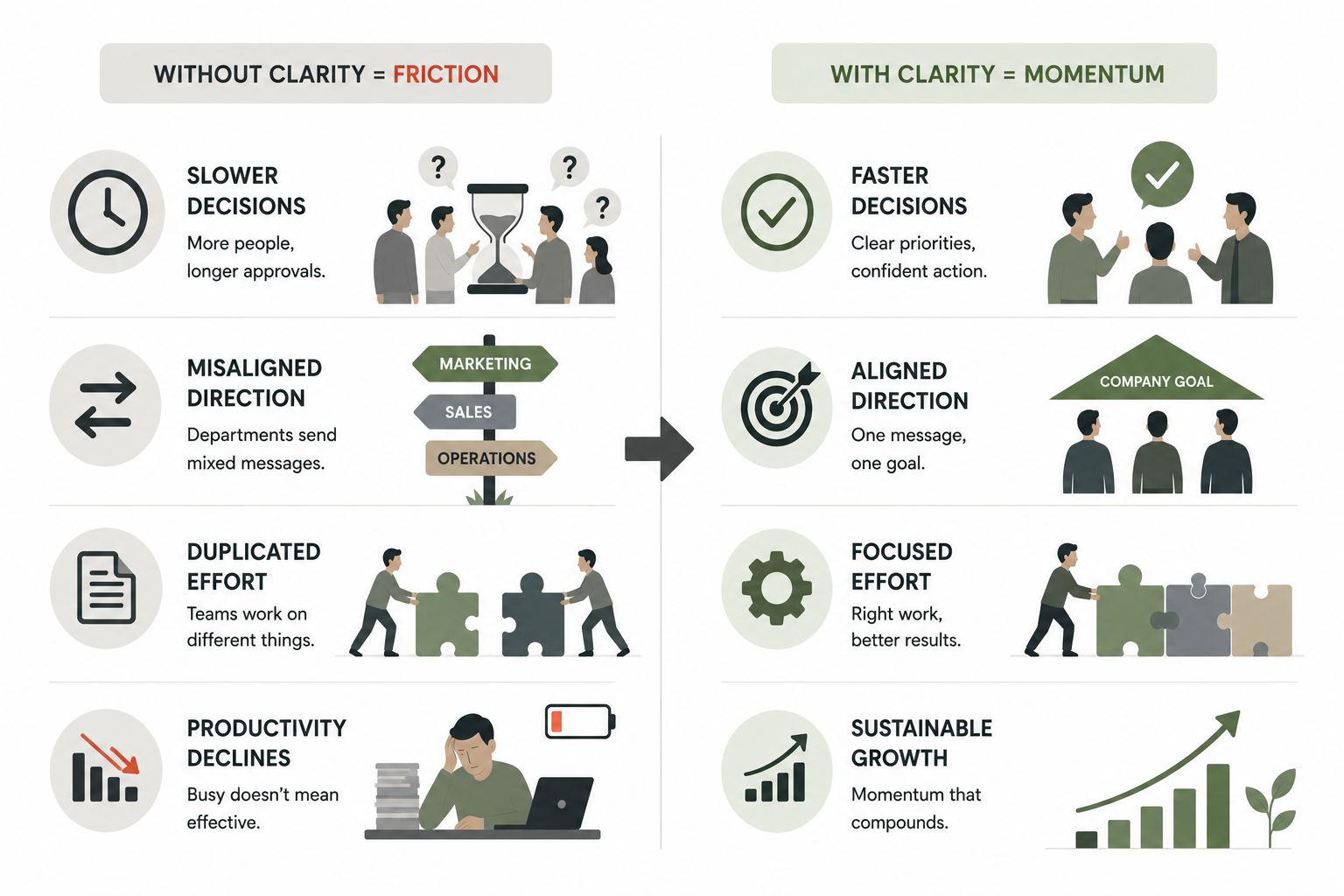
Growth naturally introduces more people, departments, customers, and initiatives, increasing the number of decisions and interactions required to keep the business moving. Without clear priorities and consistent direction, that complexity creates friction. Instead of accelerating progress, teams spend more time coordinating work, clarifying responsibilities, and resolving misunderstandings than creating meaningful results.
One of the earliest signs of declining clarity is slower decision-making. As more stakeholders become involved, approvals take longer, responsibilities become less defined, and employees hesitate because they are unsure of priorities or authority. At the same time, departments may begin solving similar problems independently or communicating inconsistent messages to customers. Marketing, sales, and operations can unintentionally move in different directions, creating confusion both internally and externally.
Unclear priorities also lead to duplicated effort and inefficient use of resources. Teams may invest time in competing initiatives that contribute little to the company's larger objectives simply because everyone has a different understanding of what matters most. The organization stays busy, but productivity quietly declines as complexity continues to increase.
Clarity removes much of this unnecessary friction. Shared priorities, consistent communication, and aligned decision-making help businesses move faster, eliminate wasted effort, and maintain momentum even as the organization continues growing.
2. How Clarity Strengthens Execution and Creates Scalable Systems
Clarity allows every department to move toward the same goals instead of working in parallel with different priorities. When marketing, sales, customer service, operations, and leadership all understand the company's direction, execution becomes faster, messaging becomes more consistent, and customers receive a more unified experience. Employees also make decisions with greater confidence because they understand both the company's objectives and the principles that guide decision-making.
As businesses grow, clarity must become part of the operating system rather than relying on constant founder involvement. Documenting the company's vision, priorities, decision-making frameworks, and operating procedures creates consistency that extends beyond any one individual. Repeatable systems, standardized workflows, automation, and clear processes reduce dependence on personal knowledge while making onboarding easier and maintaining quality as new employees join the organization.
Regularly reviewing priorities also helps businesses remain aligned as markets evolve. Clear communication across every department ensures that employees, customers, and stakeholders continue moving in the same direction even as the organization changes. Businesses that intentionally build clarity into both their leadership and systems create a stronger foundation for sustainable growth.
3. Why Clarity Becomes a Long-Term Competitive Advantage
The benefits of clarity continue growing as the business grows. While many competitive advantages can be copied, clear direction, aligned teams, and consistent execution are much harder to replicate. Businesses that prioritize clarity enable employees to act confidently, respond faster to opportunities, and spend less time correcting misunderstandings or resolving conflicting priorities.
Clear priorities also improve profitability by helping leaders allocate resources where they create the greatest long-term value. Rather than spreading budgets, talent, and attention across competing projects, businesses focus on initiatives that support their strategic objectives. Customers benefit from this consistency as well because every interaction reinforces the same message, standards, and level of service, strengthening trust and loyalty over time.
Clarity also builds confidence among employees, partners, and investors. Everyone understands the company's direction, how decisions are made, and how success is measured. Instead of reacting to confusion or shifting priorities, the business becomes proactive, adapting more effectively because everyone understands what matters most. Over time, this clarity becomes a competitive advantage that supports stronger execution, greater resilience, and more predictable long-term growth.

Conclusion
As businesses grow, complexity becomes unavoidable, but confusion does not have to be. Every new employee, customer, product, and process increases the number of decisions the organization must make. Without clear direction, even talented teams can lose focus and struggle to execute consistently. This is why clarity becomes more valuable with every stage of growth.
Clear priorities improve execution, strengthen alignment, and help employees make better decisions with greater confidence. Consistent communication, repeatable systems, and shared decision-making reduce wasted effort while creating a more reliable experience for both employees and customers. Businesses that intentionally build clarity into their operations create stronger foundations for adapting to change, scaling efficiently, and maintaining momentum.
Ultimately, the businesses that scale most successfully are often not the ones with the fastest growth but the ones that remain the clearest about where they are going, why it matters, and how every person contributes to getting there. By treating clarity as a strategic asset rather than simply a communication tool, they create the focus, consistency, and confidence needed for lasting success.
Here are five SEO-friendly FAQs that fit naturally at the end of your blog while avoiding repetition with the main content.
FAQs
1. Why does clarity become more important as a business grows?
As a business grows, it adds more employees, customers, products, systems, and processes. Without clear priorities, communication, and decision-making, this added complexity can lead to confusion, slower execution, and inconsistent customer experiences. Clarity helps keep everyone aligned and focused on the same goals.
2. What are the signs that a business lacks clarity?
Common signs include slow decision-making, conflicting priorities between departments, duplicated work, inconsistent messaging, unclear responsibilities, and employees frequently seeking clarification before taking action. These issues often become more noticeable as the business expands.
3. How can business leaders improve organizational clarity?
Leaders can improve clarity by defining clear goals, documenting processes, communicating priorities consistently, creating decision-making frameworks, and regularly reviewing business objectives. Aligning every department around the same vision also helps maintain consistency as the company grows.
4. How does clarity improve business performance?
Clarity enables teams to make faster decisions, collaborate more effectively, allocate resources more efficiently, and execute priorities with greater consistency. This reduces wasted effort, improves productivity, and creates a better experience for both employees and customers.
5. Can clarity become a competitive advantage?
Yes. Businesses with strong clarity adapt more quickly to change, maintain consistent customer experiences, and execute strategies more effectively than competitors. Over time, this creates stronger trust, better operational performance, and more sustainable long-term growth.