
Modern marketing is built around visibility. Brands compete for clicks, views, likes, and viral moments in an increasingly crowded digital landscape where attention has become one of the most valuable currencies online. Eye-catching campaigns, entertaining content, and trend-driven strategies are all designed to stop people mid-scroll and generate engagement. On the surface, this appears successful — more traffic should mean more sales. However, many businesses quickly discover that attracting attention and converting customers are two very different things.
A campaign may generate thousands of views and interactions yet still produce very few actual buyers. This happens because visibility alone does not create purchase intent. Effective marketing requires more than awareness; it requires relevance, trust, clarity, and direction. Without those elements, businesses often attract curious audiences who engage temporarily but never move toward a purchasing decision. This disconnect is commonly known as the “attention vs. conversion gap.”
1. Your Marketing May Be Reaching the Wrong People
One of the biggest reasons marketing struggles to convert is that it often attracts attention from people who were never likely to become customers in the first place. Viral or overly broad campaigns generate curiosity because they are entertaining, emotional, or highly shareable. But curiosity alone does not equal buying intent.
People naturally pay attention to content that entertains or surprises them, but that attention fades quickly if the message does not connect directly to a need or problem they want solved. A funny social media video may gain millions of views, but if the audience does not clearly understand how the product or service benefits them, the traffic becomes difficult to convert. The campaign succeeds at visibility while failing at qualification.
Broad messaging can also weaken buyer intent because it tries to appeal to everyone instead of speaking directly to ideal customers. Buyers engage more deeply when messaging reflects their exact goals, frustrations, or needs. Effective marketing is not simply about reaching more people — it is about reaching the right people with messaging that makes them feel understood and ready to act.
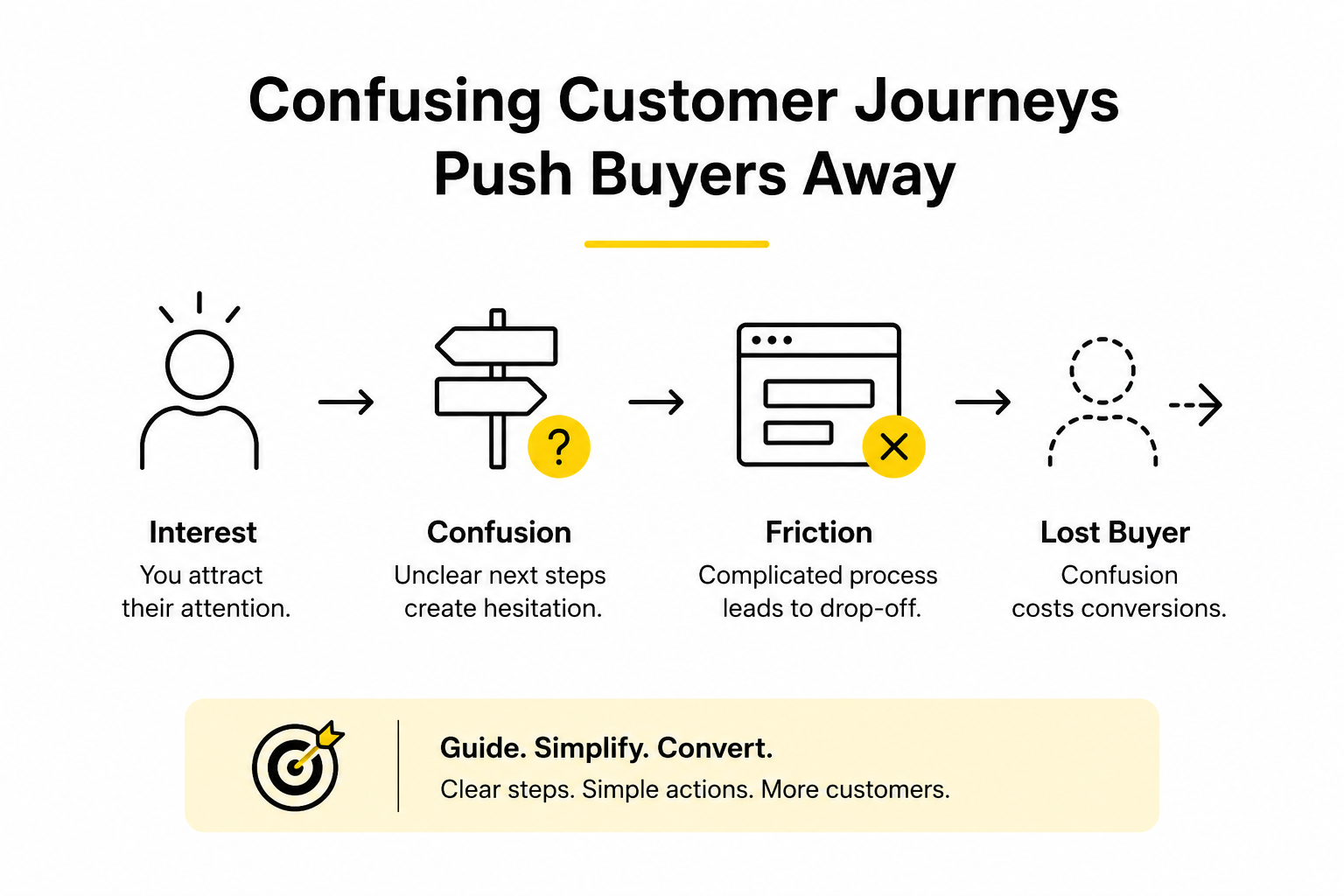
2. Confusing Customer Journeys Push Buyers Away
Attracting attention is only the first step. Once prospects become interested, they need clear guidance on what to do next. Many businesses lose potential buyers because their marketing creates curiosity without creating direction. Visitors may browse the website, enjoy the content, or consider purchasing, but confusion and friction stop them from moving forward.
One of the biggest conversion killers is an unclear call-to-action. If there is no obvious “Buy Now,” “Book a Call,” or “Get Started” step, prospects are left uncertain about how to proceed. That uncertainty quickly turns into hesitation, and hesitation often leads to abandonment.
Complicated buying experiences make the problem even worse. Long forms, cluttered landing pages, confusing navigation, or too many options create friction that weakens purchase intent. Strong marketing funnels solve this by guiding visitors smoothly from curiosity to action. Effective funnels remove confusion, reduce friction, and make the next step feel simple and obvious.
3. Trust Signals and Clear Offers Drive Conversions
Attention may bring people to a business, but trust is what convinces them to stay. Buyers rarely make decisions based on excitement alone. Before committing, they look for reassurance that the business is legitimate, reliable, and capable of delivering results.
This is why testimonials, reviews, ratings, and case studies are so important. These trust signals provide proof that real people have already benefited from the business. Positive reviews create social validation, while case studies demonstrate measurable outcomes instead of vague promises. Without proof, visitors are often left questioning whether the business can actually deliver what it claims.
Clarity also plays a major role in conversions. Generic promises such as “transform your business” or “revolutionary results” may sound impressive, but they often fail to explain what customers will actually gain. Buyers respond better to specific outcomes and clear value propositions because clarity reduces uncertainty. Businesses that communicate measurable benefits feel more credible and persuasive.

4. Follow-Up Turns Attention Into Sales
Many businesses lose ready-to-buy leads simply because they fail to follow up. Attention online fades quickly, especially when customers are constantly exposed to competing content and advertisements. Someone may show interest today but become distracted tomorrow. Without consistent nurturing, even qualified leads can disappear before making a purchase.
This is why follow-up systems are essential. Email sequences, retargeting ads, reminders, and personalized outreach help businesses stay visible while reinforcing trust and value over time. Instead of relying on a single interaction, effective marketing continues guiding prospects throughout the decision-making process.
The most successful marketing strategies balance attention, trust, and action. They attract the right audience, build confidence through proof and clarity, and guide prospects smoothly toward conversion. Businesses that understand the full customer journey grow faster because every stage of their marketing works together instead of relying on visibility alone.
Conclusion
Attention is important in marketing, but it is only the beginning. Views, clicks, and engagement may create visibility, yet visibility alone does not guarantee sales. Conversions depend on relevance, trust, clarity, and follow-up — the elements that help customers feel confident enough to move forward.
Ultimately, successful marketing is not measured by how many people notice your brand. It is measured by how many people confidently choose to buy from you.
FAQs
1. Why does my marketing get engagement but not sales?
High engagement does not always mean strong buyer intent. Many campaigns attract attention through entertaining or broad content, but fail to connect with the specific needs, problems, or motivations of potential customers.
2. What is the “attention vs. conversion gap” in marketing?
The attention vs. conversion gap happens when marketing successfully generates traffic, views, or clicks but struggles to turn that interest into actual sales. This usually occurs because of weak trust signals, unclear offers, poor targeting, or confusing customer journeys.
3. How can I tell if my marketing is attracting the wrong audience?
Signs include high traffic with low conversion rates, low-quality leads, short website visit durations, and audiences engaging with content but rarely taking action. This often means your messaging is too broad or not aligned with buyer intent.
4. Why are testimonials and reviews important for conversions?
Testimonials, reviews, and case studies act as social proof. They reassure potential buyers that real people have already trusted your business and achieved positive results, which helps reduce hesitation before purchasing.
5. How can businesses improve marketing conversion rates?
Businesses can improve conversions by targeting the right audience, creating clearer offers, simplifying the customer journey, adding stronger trust signals, and using follow-up systems like email nurturing and retargeting to keep leads engaged.