
Many businesses focus heavily on attracting customers but pay far less attention to how easy it feels to buy from them. Yet from a customer’s perspective, the buying experience often matters just as much as the product or service itself. People naturally gravitate toward businesses that make decisions feel simple, clear, and low-risk. When purchasing feels effortless, customers move forward with confidence. When it feels complicated or frustrating, hesitation quickly begins to grow.
Buying decisions are influenced by convenience, clarity, and confidence. Customers want quick answers, transparent information, and a clear understanding of what happens next. They rarely analyze every step consciously; instead, they react to how the experience feels. A smooth process creates trust, while a frustrating one creates doubt.
This is where friction becomes important. Friction refers to anything that makes customers work harder than necessary to complete a purchase. It can be obvious, such as long forms or complicated checkout processes, but it can also appear through unclear pricing, confusing navigation, slow responses, or missing trust signals. Businesses that consistently convert more customers understand that every unnecessary obstacle increases the likelihood of abandonment. Instead of creating complexity, they focus on making the path to purchase feel intuitive, transparent, and easy to trust.
Effortless Businesses Remove Uncertainty and Simplify Decisions
One of the biggest differences between businesses that convert consistently and those that struggle is how effectively they remove uncertainty. Customers make decisions faster when information is easy to find, easy to understand, and easy to trust.
Clear communication reduces hesitation. Customers should not have to search through multiple pages or contact support just to understand pricing, features, timelines, or next steps. The easier it is to find answers, the easier it becomes to move forward confidently.
Transparency also plays a major role. Hidden fees, vague pricing, and unclear policies often create suspicion because customers begin wondering what other surprises might appear later. Businesses that openly communicate expectations and costs build trust from the beginning.
Effortless businesses also simplify choices. While flexibility can be valuable, too many options often create decision fatigue. Clear recommendations, simplified offers, and easy-to-understand comparisons help customers make decisions without feeling overwhelmed. The result is a smoother journey from interest to action.
Friction Happens When Customers Have to Work Too Hard
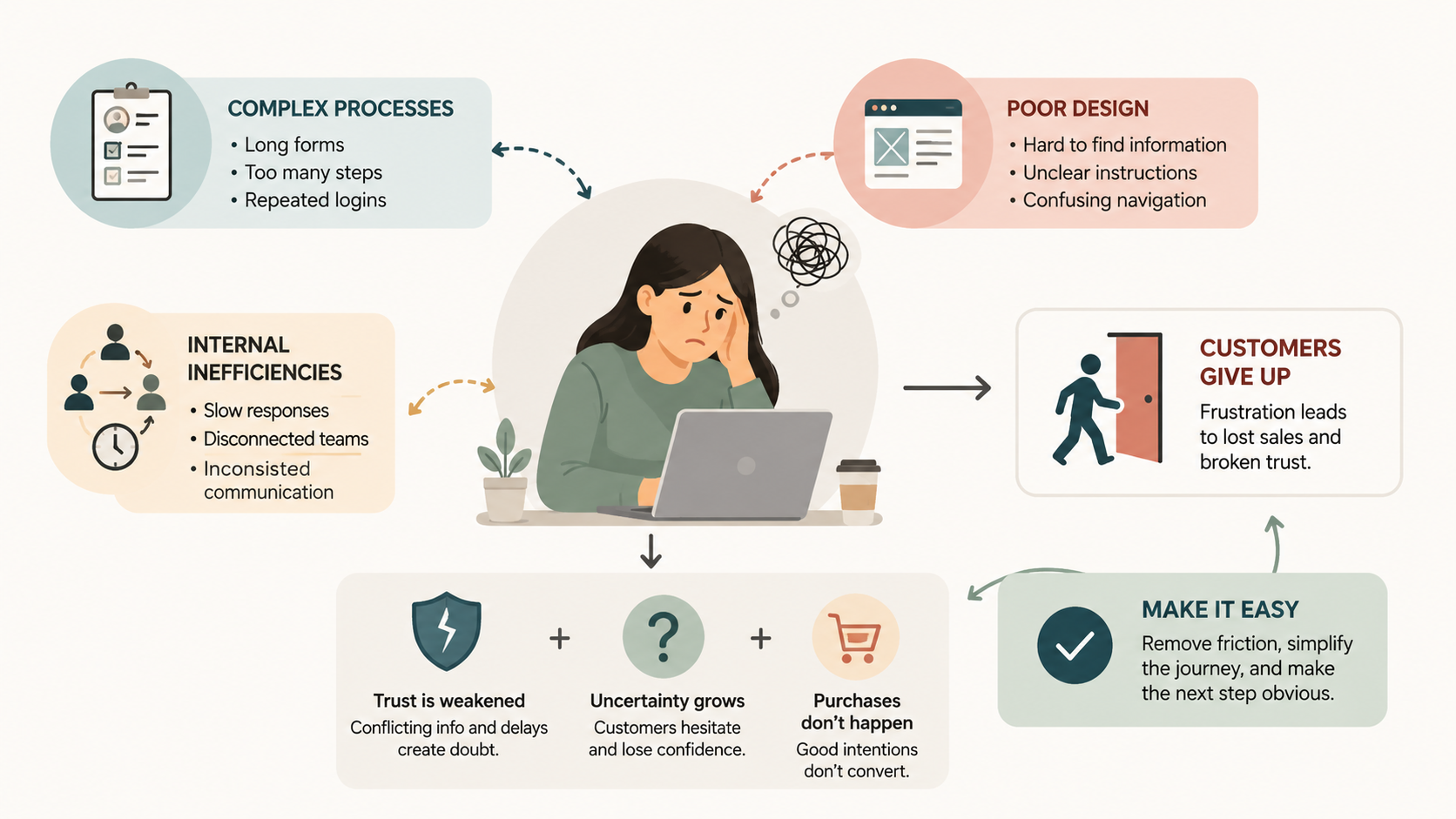
Many customers abandon purchases not because they dislike the product or service, but because the process feels unnecessarily difficult. Long forms, repeated logins, confusing navigation, and excessive steps all create resistance that weakens buying momentum.
Poor design can make this problem even worse. When information is difficult to find or instructions are unclear, customers focus more on the inconvenience of the experience than the value of the offer. Frustration quickly replaces confidence.
Friction is not always caused by the website itself. Internal inefficiencies such as slow responses, disconnected departments, or inconsistent communication often create delays that customers experience as poor service. From the customer’s perspective, it simply feels like the business is difficult to work with.
Trust can also suffer when customers receive conflicting information or struggle to get timely answers. Even small moments of uncertainty can create enough doubt to prevent someone from completing a purchase. Ultimately, friction occurs whenever customers feel they must work harder than expected to buy.
The Difference Between Bad Friction and Helpful Friction
While friction is often viewed negatively, not all friction is harmful. Some forms of friction can actually improve trust, confidence, and decision quality.
Bad friction creates confusion, delays, and uncertainty. It forces customers to invest extra effort without receiving additional value in return. This type of friction interrupts momentum and increases abandonment.
Helpful friction serves a different purpose. For expensive purchases, long-term commitments, or complex services, customers often appreciate opportunities to slow down and evaluate their options carefully. Consultation calls, qualification forms, educational content, or comparison guides may add steps to the process, but they also provide reassurance and clarity.
The goal is not to eliminate every step in the customer journey. Instead, businesses should remove frustration while preserving the moments that help customers make informed decisions. When friction builds confidence rather than confusion, it becomes a valuable part of the experience.
What Effortless Buying Experiences Have in Common
Businesses that make buying feel effortless intentionally design experiences around convenience, trust, and speed. They focus on reducing uncertainty while helping customers move forward with confidence.
Convenience is one of the most noticeable characteristics. Customers should be able to find information, ask questions, and complete purchases without unnecessary delays. Fast support, accessible contact options, and clear FAQs all help reduce uncertainty.
Streamlined checkout and booking systems also maintain momentum. Simple forms, clear instructions, visible availability, and fast confirmations make the process feel easy and efficient. The fewer obstacles customers encounter, the less likely they are to abandon the purchase.
Trust is equally important. Consistent communication, accurate information, and reliable processes create confidence at every touchpoint. Businesses that anticipate customer questions, provide proactive updates, and communicate clearly make customers feel respected and supported throughout the buying journey.
Ultimately, effortless experiences work because they reduce effort while increasing confidence. Customers feel that the business values their time, understands their needs, and makes the path forward easy to follow.
Conclusion
Customers rarely think about friction in technical terms, but they immediately notice how a buying experience feels. When the process is simple, transparent, and easy to navigate, people naturally feel more confident moving forward. Smooth buying experiences create trust because customers associate convenience with professionalism and reliability.
Friction often comes from unclear processes, poor communication, hidden information, or unnecessary complexity. While certain forms of strategic friction can improve decision-making, frustrating friction reduces confidence and weakens conversions.
The businesses that convert most effectively understand this balance. They simplify decisions, provide clear information, offer accessible support, and remove unnecessary obstacles wherever possible. By making purchasing feel simple, clear, and low-risk, they create experiences that help customers move from interest to action with confidence.
FAQs
1. What does customer friction mean in the buying process?
Customer friction refers to anything that makes it harder for people to complete a purchase. This can include confusing navigation, long forms, hidden pricing, slow responses, unclear information, or unnecessary steps that create frustration and hesitation.
2. Why do customers abandon purchases even when they want the product or service?
Many customers leave because the buying process feels too difficult, confusing, or time-consuming. Small obstacles such as repeated logins, unclear instructions, or unexpected costs can interrupt momentum and cause people to postpone or abandon their decision.
3. Is all friction bad for conversions?
No. While frustrating friction should be removed, some friction can be helpful. For example, consultation calls, qualification forms, or educational content can help customers make more informed decisions when purchasing complex, expensive, or high-risk services.
4. How can businesses make buying feel more effortless?
Businesses can reduce friction by simplifying customer journeys, providing clear pricing and policies, improving website navigation, offering fast support, streamlining checkout or booking processes, and proactively answering common customer questions.
5. Why does an effortless buying experience increase conversions?
When customers can quickly find information, understand their options, and complete a purchase without unnecessary obstacles, they feel more confident and less uncertain. This reduces hesitation and makes them more likely to move forward with the purchase.